Ch.13 Alkenes, Alkynes, and Aromatic Compounds
McMurry - Fundamentals of General, Organic, and Biological Chemistry 8th Edition
McMurry8th EditionFundamentals of General, Organic, and Biological ChemistryISBN: 9780134015187Non è quello che usi tu?Cambia libro di testo
Capitolo 13, Problema 42

When ethylbenzene is reacted with nitric acid, three possible benzenes containing both a nitro group and an ethyl group are obtained. Draw and name them.

Guida verificata passo dopo passo
1
Step 1: Understand the reaction. Ethylbenzene reacts with nitric acid in the presence of sulfuric acid, undergoing an electrophilic aromatic substitution reaction. This introduces a nitro group (-NO₂) onto the benzene ring.
Step 2: Identify the positions on the benzene ring where substitution can occur. The ethyl group (-CH₂CH₃) is an electron-donating group, which directs the incoming nitro group to the ortho and para positions relative to itself.
Step 3: Draw the three possible products. These are: (1) ortho-nitroethylbenzene, where the nitro group is adjacent to the ethyl group, (2) meta-nitroethylbenzene, where the nitro group is one position away from the ethyl group, and (3) para-nitroethylbenzene, where the nitro group is opposite the ethyl group on the benzene ring.
Step 4: Name the compounds systematically. Use IUPAC nomenclature: (1) 1-ethyl-2-nitrobenzene for the ortho product, (2) 1-ethyl-3-nitrobenzene for the meta product, and (3) 1-ethyl-4-nitrobenzene for the para product.
Step 5: Verify the stability and likelihood of formation. The ortho and para products are favored due to the electron-donating nature of the ethyl group, which stabilizes the intermediate carbocation during the reaction. The meta product is less favored but still possible.

Risposta video verificata per un problema simile:

Questa soluzione video è stata consigliata dai nostri tutor come utile per risolvere questo problema.
Durata del video:
3m

Concetti chiave

Ecco i concetti essenziali che devi comprendere per rispondere correttamente alla domanda.

Electrophilic Aromatic Substitution

Electrophilic aromatic substitution (EAS) is a fundamental reaction in organic chemistry where an electrophile replaces a hydrogen atom on an aromatic ring. In the case of ethylbenzene reacting with nitric acid, the nitronium ion (NO2+) acts as the electrophile, leading to the introduction of a nitro group onto the benzene ring. Understanding EAS is crucial for predicting the products formed in this reaction.
Video consigliato:
Percorso guidato
5:07
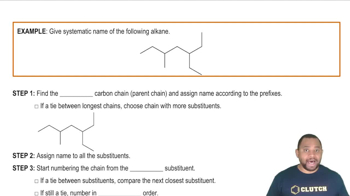
Naming Alkanes with Substituents Example 1

Regioselectivity

Regioselectivity refers to the preference of a chemical reaction to occur at one location over another in a molecule. In the context of ethylbenzene, the presence of the ethyl group influences where the nitro group can be added to the benzene ring. This is due to the electron-donating nature of the ethyl group, which stabilizes the carbocation intermediate formed during the EAS process, leading to specific regioisomers.

Nomenclature of Aromatic Compounds

The nomenclature of aromatic compounds follows specific rules set by the International Union of Pure and Applied Chemistry (IUPAC). When naming the products of the reaction between ethylbenzene and nitric acid, it is important to identify the positions of the nitro and ethyl groups on the benzene ring. The names of the resulting compounds will reflect their structure, including the positions of substituents, which is essential for clear communication in organic chemistry.
Video consigliato:
Percorso guidato
02:11
Naming Ionic Compounds