Ch.13 Alkenes, Alkynes, and Aromatic Compounds
McMurry - Fundamentals of General, Organic, and Biological Chemistry 8th Edition
McMurry8th EditionFundamentals of General, Organic, and Biological ChemistryISBN: 9780134015187Non è quello che usi tu?Cambia libro di testo
Capitolo 13, Problema 23

Reaction of Br2 and FeBr3 with phenol can lead to three possible substitution products. Show the structure of each and name them.

Guida verificata passo dopo passo
1
Phenol (C6H5OH) is an aromatic compound with an -OH group attached to the benzene ring. The -OH group is an activating group, meaning it directs electrophilic substitution reactions to the ortho and para positions of the benzene ring.
The reaction involves bromine (Br2) in the presence of a catalyst, FeBr3. FeBr3 acts as a Lewis acid, polarizing the Br2 molecule and generating the electrophile, Br⁺, which will attack the benzene ring.
The first possible product is the ortho-substituted product, 2-bromophenol. This occurs when the Br⁺ electrophile substitutes at the position adjacent to the -OH group on the benzene ring.
The second possible product is the para-substituted product, 4-bromophenol. This occurs when the Br⁺ electrophile substitutes at the position opposite the -OH group on the benzene ring.
The third possible product is the di-substituted product, 2,4-dibromophenol. This occurs when two Br⁺ electrophiles substitute at both the ortho and para positions relative to the -OH group. The structure of each product can be drawn by placing the Br atoms at the respective positions on the benzene ring.

Risposta video verificata per un problema simile:

Questa soluzione video è stata consigliata dai nostri tutor come utile per risolvere questo problema.

Concetti chiave

Ecco i concetti essenziali che devi comprendere per rispondere correttamente alla domanda.

Electrophilic Aromatic Substitution

Electrophilic aromatic substitution (EAS) is a fundamental reaction in organic chemistry where an electrophile replaces a hydrogen atom on an aromatic ring. In the case of phenol, the hydroxyl group (-OH) activates the ring, making it more reactive towards electrophiles like Br2 and FeBr3. Understanding EAS is crucial for predicting the products formed when phenol reacts with bromine.
Video consigliato:
Percorso guidato
5:07
Naming Alkanes with Substituents Example 1

Bromination of Phenol

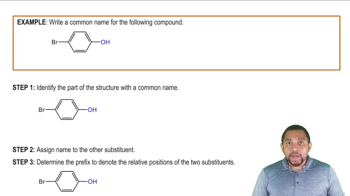
Bromination of phenol involves the introduction of bromine atoms into the aromatic ring. The reaction can yield multiple products depending on the position of substitution, typically ortho and para to the hydroxyl group. Recognizing the regioselectivity of bromination is essential for identifying the specific substitution products formed in this reaction.
Video consigliato:
Percorso guidato
1:07
Common Naming of Disubstituted Benzene Example 3

Substitution Product Structures

The substitution products of phenol with bromine include ortho-bromophenol, para-bromophenol, and brominated phenol derivatives. Each product has a distinct molecular structure based on the position of the bromine atom relative to the hydroxyl group. Drawing and naming these structures is vital for a complete understanding of the reaction outcomes.
Video consigliato:
Percorso guidato
03:19
Solubility Product Constant (Ksp) Concept 3