Ch.13 Alkenes, Alkynes, and Aromatic Compounds
McMurry - Fundamentals of General, Organic, and Biological Chemistry 8th Edition
McMurry8th EditionFundamentals of General, Organic, and Biological ChemistryISBN: 9780134015187Non è quello che usi tu?Cambia libro di testo
Capitolo 13, Problema 30a

What do the terms saturated and unsaturated mean?

Guida verificata passo dopo passo
1
Understand that the terms 'saturated' and 'unsaturated' are used to describe the types of bonds in organic molecules, particularly hydrocarbons.
Recognize that a 'saturated' hydrocarbon contains only single bonds between carbon atoms. This means each carbon atom is bonded to as many hydrogen atoms as possible, following the general formula C_nH_{2n+2} for alkanes.
Identify that an 'unsaturated' hydrocarbon contains one or more double or triple bonds between carbon atoms. This reduces the number of hydrogen atoms in the molecule compared to a saturated hydrocarbon.
Note that unsaturated hydrocarbons can be further classified into alkenes, which have at least one double bond (C=C), and alkynes, which have at least one triple bond (C≡C).
Remember that the presence of double or triple bonds in unsaturated hydrocarbons affects their chemical reactivity and physical properties, such as boiling and melting points.

Risposta video verificata per un problema simile:

Questa soluzione video è stata consigliata dai nostri tutor come utile per risolvere questo problema.

Concetti chiave

Ecco i concetti essenziali che devi comprendere per rispondere correttamente alla domanda.

Saturated Compounds

Saturated compounds are organic molecules that contain only single bonds between carbon atoms. This means that each carbon atom is bonded to the maximum number of hydrogen atoms possible, resulting in a structure that is 'saturated' with hydrogen. Common examples include alkanes, such as ethane and propane, which are typically found in fuels and fats.
Video consigliato:
Percorso guidato
02:11
Naming Ionic Compounds

Unsaturated Compounds

Unsaturated compounds contain one or more double or triple bonds between carbon atoms, which means they do not hold the maximum number of hydrogen atoms. This results in a more reactive structure compared to saturated compounds. Examples include alkenes, like ethylene, and alkynes, like acetylene, which are important in various chemical reactions and industrial applications.
Video consigliato:
Percorso guidato
02:11
Naming Ionic Compounds

Hydrocarbon Structure

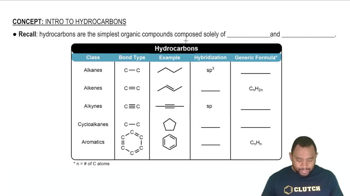
The structure of hydrocarbons, which are compounds made solely of carbon and hydrogen, is fundamental to understanding saturation. Hydrocarbons can be classified as either saturated or unsaturated based on the types of bonds present. This classification affects their physical properties, reactivity, and roles in biological systems, making it essential for fields like organic chemistry and biochemistry.
Video consigliato:
Percorso guidato
4:29
Intro to Hydrocarbons Concept 1