Ch.13 Alkenes, Alkynes, and Aromatic Compounds
McMurry - Fundamentals of General, Organic, and Biological Chemistry 8th Edition
McMurry8th EditionFundamentals of General, Organic, and Biological ChemistryISBN: 9780134015187Non è quello che usi tu?Cambia libro di testo
Capitolo 13, Problema 31b

What is resonance and why is it important in aromatic compounds?

Guida verificata passo dopo passo
1
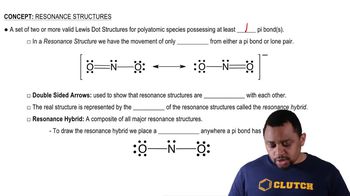
Resonance is a concept in chemistry where a molecule or ion can be represented by two or more valid Lewis structures, called resonance structures. These structures differ only in the arrangement of electrons, not the arrangement of atoms.
In resonance, the actual structure of the molecule is a hybrid of all the resonance structures. This hybrid is more stable than any individual resonance structure due to the delocalization of electrons.
Aromatic compounds, such as benzene, exhibit resonance because their π-electrons are delocalized over the entire ring structure. This delocalization creates a stable, conjugated system.
The resonance in aromatic compounds is important because it contributes to their unique chemical properties, such as increased stability (aromaticity) and specific reactivity patterns in chemical reactions.
To identify resonance in a molecule, look for conjugated systems with alternating single and double bonds, or lone pairs adjacent to double bonds, which allow for the delocalization of electrons.

Risposta video verificata per un problema simile:

Questa soluzione video è stata consigliata dai nostri tutor come utile per risolvere questo problema.

Concetti chiave

Ecco i concetti essenziali che devi comprendere per rispondere correttamente alla domanda.

Resonance

Resonance is a concept in chemistry that describes the delocalization of electrons within molecules. It occurs when a molecule can be represented by two or more valid Lewis structures, known as resonance structures. The actual structure of the molecule is a hybrid of these forms, leading to increased stability and unique properties.
Video consigliato:
Percorso guidato
01:59
Resonance Structures (Simplified) Concept 1

Aromatic Compounds

Aromatic compounds are a class of cyclic molecules that exhibit resonance and follow Huckel's rule, which states that they must have a planar structure with a specific number of π electrons (4n + 2, where n is a non-negative integer). This unique arrangement contributes to their stability and distinctive chemical behavior, making them essential in organic chemistry.
Video consigliato:
Percorso guidato
02:11
Naming Ionic Compounds

Importance of Resonance in Aromatic Compounds

The importance of resonance in aromatic compounds lies in its contribution to their stability and reactivity. The delocalization of π electrons across the ring structure lowers the overall energy of the molecule, making it less reactive than non-aromatic compounds. This stability is crucial for the formation of various chemical reactions and the development of complex organic molecules.
Video consigliato:
Percorso guidato
01:59
Resonance Structures (Simplified) Concept 1