Ch.14 Some Compounds with Oxygen, Sulfur, or a Halogen
McMurry - Fundamentals of General, Organic, and Biological Chemistry 8th Edition
McMurry8th EditionFundamentals of General, Organic, and Biological ChemistryISBN: 9780134015187Non è quello che usi tu?Cambia libro di testo
Capitolo 14, Problema 19

2-Aminopropane is an achiral molecule, but 2-aminobutane is chiral. Explain.

Guida verificata passo dopo passo
1
Identify the concept of chirality: A molecule is chiral if it has a carbon atom bonded to four different groups, making it non-superimposable on its mirror image. If a molecule lacks this property, it is achiral.
Analyze the structure of 2-aminopropane: The central carbon atom in 2-aminopropane is bonded to a methyl group (-CH3), an amino group (-NH2), a hydrogen atom (-H), and another methyl group (-CH3). Since two of the groups are identical (both are methyl groups), the central carbon does not have four different groups, making the molecule achiral.
Analyze the structure of 2-aminobutane: The central carbon atom in 2-aminobutane is bonded to a methyl group (-CH3), an amino group (-NH2), a hydrogen atom (-H), and an ethyl group (-CH2CH3). Since all four groups are different, the central carbon is a chiral center, making the molecule chiral.
Compare the two molecules: The key difference lies in the groups attached to the central carbon. In 2-aminopropane, the presence of two identical methyl groups prevents chirality, while in 2-aminobutane, the presence of four distinct groups creates a chiral center.
Conclude: 2-Aminopropane is achiral because it lacks a chiral center, while 2-aminobutane is chiral due to the presence of a carbon atom bonded to four different groups.

Risposta video verificata per un problema simile:

Questa soluzione video è stata consigliata dai nostri tutor come utile per risolvere questo problema.

Concetti chiave

Ecco i concetti essenziali che devi comprendere per rispondere correttamente alla domanda.

Chirality

Chirality refers to the geometric property of a molecule that makes it non-superimposable on its mirror image. A chiral molecule typically has a carbon atom bonded to four different substituents, resulting in two distinct forms known as enantiomers. In contrast, achiral molecules can be superimposed on their mirror images, indicating a lack of this asymmetry.
Video consigliato:
Percorso guidato
1:39
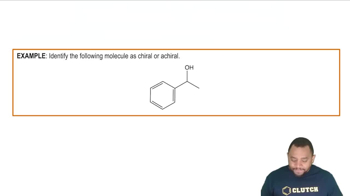
Chirality Example 1

Stereocenters

A stereocenter, often a chiral center, is a specific atom in a molecule, usually carbon, that has four different groups attached to it. The presence of a stereocenter is a key factor in determining whether a molecule is chiral. In the case of 2-aminobutane, the presence of a stereocenter makes it chiral, while 2-aminopropane lacks such a center, rendering it achiral.

Molecular Structure

The molecular structure of a compound refers to the arrangement of atoms within the molecule and the bonds that connect them. This arrangement influences the molecule's properties, including its chirality. For example, 2-aminopropane has a symmetrical structure that does not allow for chirality, while 2-aminobutane's structure introduces asymmetry, leading to its chiral nature.
Video consigliato:
Percorso guidato
00:34
Molecular Models Example 1