Ch.14 Some Compounds with Oxygen, Sulfur, or a Halogen
McMurry - Fundamentals of General, Organic, and Biological Chemistry 8th Edition
McMurry8th EditionFundamentals of General, Organic, and Biological ChemistryISBN: 9780134015187Non è quello che usi tu?Cambia libro di testo
Capitolo 14, Problema 20

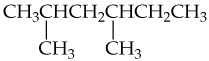
Which of the following molecules are chiral? (Hint: Draw each molecule and analyze it as illustrated in Worked Example 14.2.)
a. 3-Chloropentane
b. 2-Chloropentane
c.

Guida verificata passo dopo passo
1
Step 1: Understand the concept of chirality. A molecule is chiral if it has a carbon atom (called a chiral center) bonded to four different groups, and it cannot be superimposed on its mirror image. Molecules lacking symmetry are often chiral.
Step 2: For each molecule, draw its structural formula. For example, for 3-chloropentane, draw a pentane chain with a chlorine atom attached to the third carbon. Similarly, draw 2-chloropentane and analyze the provided image structure.
Step 3: Identify the carbon atoms in each molecule and check if any of them are bonded to four different groups. For 3-chloropentane, examine the third carbon atom and its attached groups. For 2-chloropentane, examine the second carbon atom and its attached groups.
Step 4: Determine if the molecule has a plane of symmetry. If a molecule has a plane of symmetry, it is achiral. If no plane of symmetry exists and a chiral center is present, the molecule is chiral.
Step 5: Repeat the analysis for the molecule represented by the image. Identify any chiral centers and check for symmetry. Compare your findings to determine which molecules are chiral.

Risposta video verificata per un problema simile:

Questa soluzione video è stata consigliata dai nostri tutor come utile per risolvere questo problema.

Concetti chiave

Ecco i concetti essenziali che devi comprendere per rispondere correttamente alla domanda.

Chirality

Chirality refers to the geometric property of a molecule that makes it non-superimposable on its mirror image. A chiral molecule typically has a carbon atom bonded to four different substituents, resulting in two distinct forms known as enantiomers. Understanding chirality is crucial for determining the optical activity of compounds, which is important in fields like pharmaceuticals.
Video consigliato:
Percorso guidato
1:39
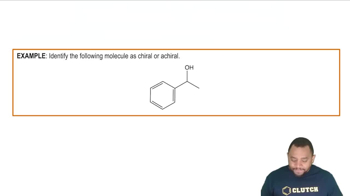
Chirality Example 1

Stereocenters

A stereocenter, often a chiral center, is a specific atom in a molecule, usually carbon, that has four different groups attached to it. The presence of a stereocenter is a key indicator of chirality, as it leads to the existence of enantiomers. Identifying stereocenters in a molecule is essential for assessing its chirality and understanding its chemical behavior.

Molecular Drawing and Analysis

Molecular drawing involves creating a visual representation of a molecule, which helps in analyzing its structure and identifying features like chirality. By drawing each molecule and examining its substituents, one can determine if it possesses a stereocenter. This analytical approach is vital for solving problems related to chirality and understanding the spatial arrangement of atoms in organic compounds.
Video consigliato:
Percorso guidato
06:11
Dimensional Analysis