The boiling point of propanol is 97 °C ,much higher than that of either ethanethiol (37 °C) or chloroethane (13 °C) , even though all three compounds have similar MWs. Explain.
Ch.14 Some Compounds with Oxygen, Sulfur, or a Halogen
McMurry8th EditionFundamentals of General, Organic, and Biological ChemistryISBN: 9780134015187Non è quello che usi tu?Cambia libro di testo
Tutti i libri di testo
McMurry 8th Edition
Ch.14 Some Compounds with Oxygen, Sulfur, or a Halogen
Problema 56b
McMurry 8th Edition
Ch.14 Some Compounds with Oxygen, Sulfur, or a Halogen
Problema 56bCapitolo 14, Problema 56b
Define the following terms:
b. Achiral
Guida verificata passo dopo passo1
Step 1: Begin by understanding the concept of chirality. Chirality refers to the property of a molecule that makes it non-superimposable on its mirror image, much like how your left and right hands are mirror images but cannot be perfectly aligned.
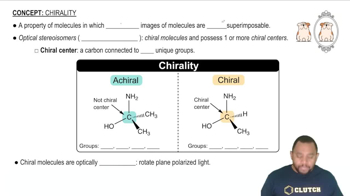
Step 2: Define achiral. Achiral molecules are those that are superimposable on their mirror images. This means that the molecule and its mirror image are identical in all respects.
Step 3: Recognize the structural characteristics of achiral molecules. Achiral molecules often have a plane of symmetry or a center of symmetry, which allows them to be superimposable on their mirror images.
Step 4: Provide an example of an achiral molecule. For instance, methane (CH₄) is achiral because it has a tetrahedral geometry and is symmetric, making it identical to its mirror image.
Step 5: Summarize the distinction between achiral and chiral molecules. Achiral molecules lack the property of chirality and are superimposable on their mirror images, whereas chiral molecules are not superimposable and exist as enantiomers (mirror-image pairs).

Risposta video verificata per un problema simile:
Questa soluzione video è stata consigliata dai nostri tutor come utile per risolvere questo problema.
Concetti chiave
Ecco i concetti essenziali che devi comprendere per rispondere correttamente alla domanda.
Chirality
Chirality is a property of asymmetry important in several branches of science, particularly in chemistry and biology. A molecule is considered chiral if it cannot be superimposed on its mirror image, much like left and right hands. This property is crucial in understanding the behavior of molecules in biological systems, as chiral molecules can have different effects based on their orientation.
Video consigliato:
Percorso guidato
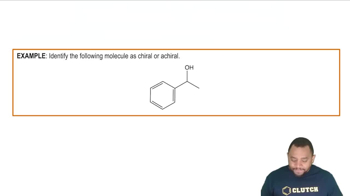
Chirality Example 1
Achirality
Achirality refers to the property of a molecule that is superimposable on its mirror image, meaning it does not have a chiral center. Achiral molecules can be symmetrical or possess a plane of symmetry, which allows them to be identical to their mirror images. Common examples include simple molecules like carbon dioxide (CO2) and methane (CH4), which do not exhibit chirality.
Video consigliato:
Percorso guidato
Chirality Concept 1
Stereoisomerism
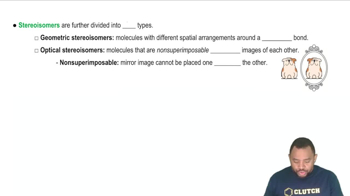
Stereoisomerism is a form of isomerism where molecules have the same molecular formula and connectivity of atoms but differ in the spatial arrangement of their atoms. This concept is closely related to chirality, as chiral molecules can exist as stereoisomers known as enantiomers, which are non-superimposable mirror images. Understanding stereoisomerism is essential for grasping the implications of chirality in chemical reactions and biological interactions.
Video consigliato:
Percorso guidato
Stereoisomers Concept 2
Pratica correlata
Domanda del libro di testo
39
views
Domanda del libro di testo
Identify the chiral center(s) in each of the following molecules:
a. 2-Methyl-3-pentanol
945
views
Domanda del libro di testo
Oxidation of a dithiol such as 2,5-hexanedithiol forms a six-membered ring containing a disulfide group as part of the ring. Draw the structure of this cyclic disulfide (Hint: Draw the starting compound in line structure format first).
644
views
Domanda del libro di testo
Are the following molecules chiral or achiral? If they are chiral, identify the chiral carbon atom(s).
d.
774
views
Domanda del libro di testo
Propanol is very soluble in water, but ethanethiol and chloroethane are only slightly soluble. Explain.
56
views
Domanda del libro di testo
Define the following terms:
c. Chiral carbon
1651
views