
Ch.14 Some Compounds with Oxygen, Sulfur, or a Halogen
McMurry - Fundamentals of General, Organic, and Biological Chemistry 8th Edition
McMurry8th EditionFundamentals of General, Organic, and Biological ChemistryISBN: 9780134015187Non è quello che usi tu?Cambia libro di testo
Capitolo 14, Problema 46e

The following alkenes can be prepared by dehydration of an appropriate alcohol. Show the structure of the alcohol in each case that would provide the alkene shown as the major product.
e. 1,4-Pentadiene

Guida verificata passo dopo passo
1
Identify the alkene structure: 1,4-Pentadiene is a diene with double bonds located between carbons 1 and 2, and carbons 4 and 5 in a five-carbon chain. The structure is CH₂=CH-CH₂-CH=CH₂.
Recall the dehydration reaction: Dehydration of an alcohol involves the removal of a water molecule (H₂O) to form a double bond. This typically occurs under acidic conditions and heat.
Determine the alcohol precursor for each double bond: For the double bond between carbons 1 and 2, the alcohol precursor would have an -OH group on carbon 1. For the double bond between carbons 4 and 5, the alcohol precursor would have an -OH group on carbon 4.
Combine the alcohol precursors: The alcohol that would yield 1,4-Pentadiene as the major product must have hydroxyl groups (-OH) on both carbon 1 and carbon 4. The structure of the alcohol is HO-CH₂-CH₂-CH₂-CH(OH)-CH₃.
Verify the reaction: When this alcohol undergoes dehydration, the removal of water molecules from carbons 1 and 2, and carbons 4 and 5, will result in the formation of 1,4-Pentadiene as the major product.

Risposta video verificata per un problema simile:

Questa soluzione video è stata consigliata dai nostri tutor come utile per risolvere questo problema.

Concetti chiave

Ecco i concetti essenziali che devi comprendere per rispondere correttamente alla domanda.

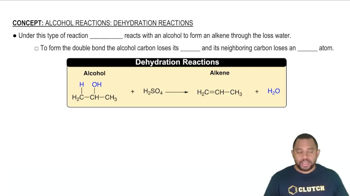
Dehydration Reaction

A dehydration reaction involves the removal of a water molecule from an alcohol, resulting in the formation of an alkene. This process typically requires an acid catalyst and can lead to the formation of multiple products, but the major product is determined by the stability of the resulting alkene, often following Zaitsev's rule.
Video consigliato:
Percorso guidato
1:30
Alcohol Reactions: Dehydration Reactions Concept 1

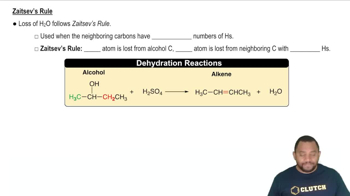
Zaitsev's Rule

Zaitsev's rule states that in elimination reactions, the more substituted alkene is usually the major product. This is because more substituted alkenes are generally more stable due to hyperconjugation and the inductive effect, making it essential to consider the structure of the alcohol to predict the major alkene formed.
Video consigliato:
Percorso guidato
1:24
Zaitsev’s Rule Concept 2

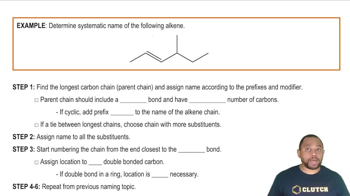
Structure of Alkenes

Alkenes are hydrocarbons that contain at least one carbon-carbon double bond. The structure of an alkene, such as 1,4-pentadiene, is crucial for understanding how to derive the corresponding alcohol. The positioning of the double bonds in the alkene influences the choice of alcohol for dehydration, as the alcohol must have the appropriate carbon skeleton to yield the desired alkene.
Video consigliato:
Percorso guidato
3:26
Naming Alkenes Example 1