
Ch.15 Aldehydes and Ketones
McMurry - Fundamentals of General, Organic, and Biological Chemistry 8th Edition
McMurry8th EditionFundamentals of General, Organic, and Biological ChemistryISBN: 9780134015187Non è quello che usi tu?Cambia libro di testo
Capitolo 15, Problema 15b

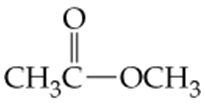
Draw the structures of the hemiacetals or hemiketals formed in these reactions: 
b.

Guida verificata passo dopo passo
1
Identify the functional groups in the reactants. A hemiacetal is formed when an aldehyde reacts with an alcohol, while a hemiketal is formed when a ketone reacts with an alcohol.
Locate the carbonyl group (C=O) in the aldehyde or ketone reactant. This is the site where the reaction will occur.
Determine the nucleophilic attack of the alcohol's hydroxyl group (-OH) on the carbonyl carbon. This forms a new bond between the carbonyl carbon and the oxygen of the alcohol.
Add a hydrogen atom from the alcohol to the oxygen of the carbonyl group, converting it into a hydroxyl group (-OH). This step completes the formation of the hemiacetal or hemiketal structure.
Draw the final structure, ensuring that the carbonyl carbon now has one hydroxyl group (-OH) and one ether group (-OR) attached, which are characteristic of hemiacetals and hemiketals.

Risposta video verificata per un problema simile:

Questa soluzione video è stata consigliata dai nostri tutor come utile per risolvere questo problema.

Concetti chiave

Ecco i concetti essenziali che devi comprendere per rispondere correttamente alla domanda.

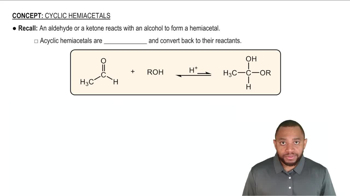
Hemiacetals and Hemiketals

Hemiacetals and hemiketals are organic compounds formed when an alcohol reacts with an aldehyde or ketone, respectively. A hemiacetal consists of a carbon atom bonded to an -OH group, an -OR group (from the alcohol), a hydrogen atom, and an alkyl or aryl group. Hemiketals have a similar structure but involve ketones instead of aldehydes. Understanding their formation is crucial for analyzing reactions involving carbonyl compounds.
Video consigliato:
Percorso guidato
2:10
Cyclic Hemiacetals Concept 1

Reaction Mechanism

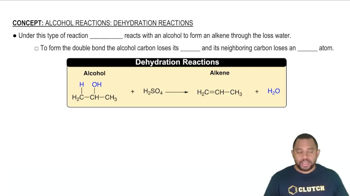
The reaction mechanism describes the step-by-step process by which reactants are converted into products. In the case of hemiacetal and hemiketal formation, the mechanism typically involves nucleophilic attack by the alcohol on the carbonyl carbon, followed by proton transfer and the formation of the new C-O bond. Familiarity with these mechanisms helps in predicting the products of organic reactions and understanding their stereochemistry.
Video consigliato:
Percorso guidato
1:30
Alcohol Reactions: Dehydration Reactions Concept 1

Equilibrium in Organic Reactions

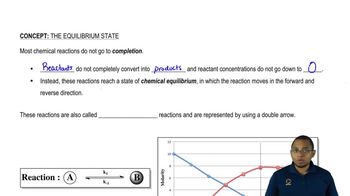
Many organic reactions, including the formation of hemiacetals and hemiketals, are reversible and can reach an equilibrium state. This means that the reactants and products can interconvert, and the position of equilibrium can be influenced by factors such as concentration, temperature, and the presence of catalysts. Recognizing the dynamic nature of these reactions is essential for predicting the predominant species in a given reaction environment.
Video consigliato:
Percorso guidato
03:42
Chemical Equilibrium Concept 1