Ch.15 Aldehydes and Ketones
McMurry - Fundamentals of General, Organic, and Biological Chemistry 8th Edition
McMurry8th EditionFundamentals of General, Organic, and Biological ChemistryISBN: 9780134015187Non è quello che usi tu?Cambia libro di testo
Capitolo 15, Problema 20a

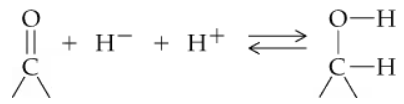
The carbonyl group can be reduced by addition of a hydride ion (H–) and (H+) a proton. Removal of H– and H+ from an alcohol results in a carbonyl group.

a. To which atom of the carbonyl is the hydride ion added and why?

Guida verificata passo dopo passo
1
The carbonyl group consists of a carbon atom double-bonded to an oxygen atom (C=O). This bond is polar because oxygen is more electronegative than carbon, creating a partial negative charge (δ⁻) on the oxygen and a partial positive charge (δ⁺) on the carbon.
The hydride ion (H⁻) is a nucleophile, meaning it is electron-rich and seeks out electron-deficient regions. In the carbonyl group, the carbon atom is electron-deficient due to the partial positive charge (δ⁺), making it the site where the hydride ion will attack.
When the hydride ion (H⁻) adds to the carbon atom of the carbonyl group, it forms a single bond with the carbon, breaking the double bond between carbon and oxygen. This results in the formation of an alkoxide ion (R-CH-O⁻).
The addition of a proton (H⁺) to the alkoxide ion neutralizes the negative charge on the oxygen, resulting in the formation of an alcohol (R-CH-OH).
In summary, the hydride ion is added to the carbon atom of the carbonyl group because the carbon is electron-deficient (δ⁺), making it susceptible to nucleophilic attack by the electron-rich hydride ion.

Risposta video verificata per un problema simile:

Questa soluzione video è stata consigliata dai nostri tutor come utile per risolvere questo problema.

Concetti chiave

Ecco i concetti essenziali che devi comprendere per rispondere correttamente alla domanda.

Carbonyl Group

The carbonyl group is a functional group characterized by a carbon atom double-bonded to an oxygen atom (C=O). It is a key feature in various organic compounds, including aldehydes and ketones. Understanding the structure and reactivity of the carbonyl group is essential for grasping how it interacts with nucleophiles, such as hydride ions, during reduction reactions.
Video consigliato:
Percorso guidato
1:00
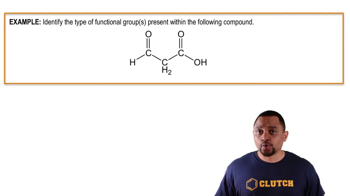
Functional Groups with Carbonyls Example 3

Hydride Ion (H⁻)

A hydride ion is a negatively charged ion (anion) consisting of one hydrogen atom with an extra electron. In organic chemistry, hydride ions act as strong nucleophiles, meaning they can donate electrons to electrophilic centers, such as the carbon atom in a carbonyl group. This donation leads to the reduction of the carbonyl compound, converting it into an alcohol.
Video consigliato:
Percorso guidato
02:31
Polyatomic Ions

Reduction Reaction

Reduction is a chemical reaction that involves the gain of electrons or the decrease in oxidation state by a molecule, atom, or ion. In the context of carbonyl compounds, reduction typically involves the addition of hydrogen (from hydride ions) to the carbonyl carbon, transforming it into an alcohol. Understanding reduction is crucial for predicting the outcomes of reactions involving carbonyl groups.
Video consigliato:
Percorso guidato
2:38
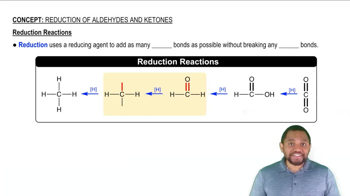
Reduction Reactions Concept 1