Ch.15 Aldehydes and Ketones
McMurry - Fundamentals of General, Organic, and Biological Chemistry 8th Edition
McMurry8th EditionFundamentals of General, Organic, and Biological ChemistryISBN: 9780134015187Non è quello che usi tu?Cambia libro di testo
Capitolo 15, Problema 46

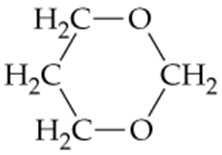
What two products result from the complete hydrolysis of this cyclic acetal?

Guida verificata passo dopo passo
1
Identify the structure of the cyclic acetal in the image. Cyclic acetals are formed when a carbon atom is bonded to two -OR groups (alkoxy groups) and one -R group (alkyl group). This structure is typically derived from the reaction of an aldehyde or ketone with a diol.
Understand the concept of hydrolysis. Hydrolysis is a reaction where water breaks chemical bonds. In the case of cyclic acetals, hydrolysis breaks the acetal bond, regenerating the original carbonyl compound (aldehyde or ketone) and the diol used to form the acetal.
Determine the carbonyl compound. Look at the carbon atom in the cyclic acetal that is bonded to the two -OR groups. When hydrolyzed, this carbon will revert to its original carbonyl form (C=O), either as an aldehyde or ketone, depending on the structure.
Determine the diol. The two -OR groups in the cyclic acetal are derived from a diol. Identify the diol by examining the two oxygen atoms in the cyclic structure and the carbon chain connecting them.
Write the products of the reaction. The complete hydrolysis of the cyclic acetal will yield the carbonyl compound (aldehyde or ketone) and the diol. Ensure the chemical structures are balanced and consistent with the original cyclic acetal.

Risposta video verificata per un problema simile:

Questa soluzione video è stata consigliata dai nostri tutor come utile per risolvere questo problema.

Concetti chiave

Ecco i concetti essenziali che devi comprendere per rispondere correttamente alla domanda.

Cyclic Acetal Structure

Cyclic acetals are formed from the reaction of aldehydes or ketones with alcohols, resulting in a stable ring structure. Understanding the molecular structure of cyclic acetals is crucial for predicting their behavior during hydrolysis, as the ring must be opened to revert to the original carbonyl compound and alcohol.
Video consigliato:
Percorso guidato
2:49
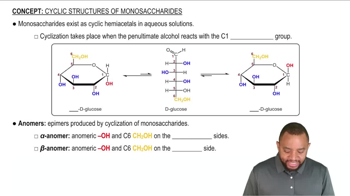
Cyclic Structures of Monosaccharides Concept 1

Hydrolysis Reaction

Hydrolysis is a chemical reaction involving the breakdown of a compound by water. In the case of cyclic acetals, hydrolysis leads to the cleavage of the acetal bond, resulting in the formation of the corresponding carbonyl compound and alcohol. Recognizing the conditions under which hydrolysis occurs is essential for determining the products.
Video consigliato:
Percorso guidato
3:09
Triacylglycerol Reactions: Hydrolysis Concept 1

Products of Hydrolysis

The complete hydrolysis of a cyclic acetal typically yields a carbonyl compound (aldehyde or ketone) and an alcohol. Identifying these products requires knowledge of the specific acetal structure and the nature of the original carbonyl compound. This understanding is vital for predicting the outcome of the hydrolysis reaction.
Video consigliato:
Percorso guidato
0:52
Basic Hydrolysis Example 2