Ch.15 Aldehydes and Ketones
McMurry - Fundamentals of General, Organic, and Biological Chemistry 8th Edition
McMurry8th EditionFundamentals of General, Organic, and Biological ChemistryISBN: 9780134015187Non è quello che usi tu?Cambia libro di testo
Capitolo 15, Problema 43a

Write the structures of the hemiacetal or hemiketal that result from reactions (a) and (b). Write the structures of the complete hydrolysis products of the acetal or ketal in (c) and (d).
a. Acetone + Ethanol → ?

Guida verificata passo dopo passo
1
Step 1: Understand the reaction type. Acetone (a ketone) reacts with ethanol (an alcohol) to form a hemiketal. A hemiketal is formed when a ketone reacts with one equivalent of an alcohol under acidic or basic conditions.
Step 2: Identify the functional groups involved. Acetone contains a carbonyl group (C=O), and ethanol contains a hydroxyl group (-OH). The reaction involves the nucleophilic attack of the alcohol's oxygen on the carbonyl carbon of the ketone.
Step 3: Draw the intermediate structure. The oxygen atom of ethanol attacks the carbonyl carbon of acetone, forming a tetrahedral intermediate. This intermediate has a hydroxyl group (-OH) and an ethoxy group (-OCH2CH3) attached to the same carbon.
Step 4: Write the structure of the hemiketal. The final structure of the hemiketal will have the central carbon bonded to: (1) a hydroxyl group (-OH), (2) an ethoxy group (-OCH2CH3), (3) a methyl group (-CH3), and (4) another methyl group (-CH3).
Step 5: Verify the reaction conditions. Ensure that the reaction is not proceeding further to form a full ketal, which would require an additional equivalent of ethanol and acidic conditions to replace the hydroxyl group with another ethoxy group.

Risposta video verificata per un problema simile:

Questa soluzione video è stata consigliata dai nostri tutor come utile per risolvere questo problema.

Concetti chiave

Ecco i concetti essenziali che devi comprendere per rispondere correttamente alla domanda.

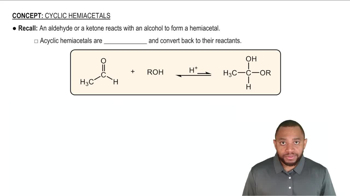
Hemiacetals and Hemiketals

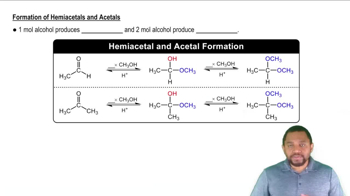
Hemiacetals and hemiketals are organic compounds formed when an alcohol reacts with an aldehyde or ketone, respectively. In this reaction, one molecule of alcohol adds to the carbonyl carbon, resulting in a structure that contains both an alcohol and an ether functional group. Hemiacetals and hemiketals are typically unstable and can further react to form acetals or ketals when a second alcohol molecule is added.
Video consigliato:
Percorso guidato
2:10
Cyclic Hemiacetals Concept 1

Acetals and Ketals

Acetals and ketals are derived from hemiacetals and hemiketals through a condensation reaction with an alcohol, resulting in the loss of water. Acetals are formed from aldehydes, while ketals are formed from ketones. These compounds are more stable than their hemi counterparts and are characterized by having two alkoxy groups attached to the carbon that was originally part of the carbonyl group.
Video consigliato:
Percorso guidato
2:17
Formation of Hemiacetals and Acetals Concept 2

Hydrolysis of Acetals and Ketals

Hydrolysis of acetals and ketals involves the reaction of these compounds with water, leading to the regeneration of the original aldehyde or ketone and the alcohol. This reaction is typically catalyzed by an acid and is reversible. Understanding this process is crucial for predicting the products of reactions involving acetals and ketals, especially in the context of organic synthesis and reaction mechanisms.
Video consigliato:
Percorso guidato
2:17
Formation of Hemiacetals and Acetals Concept 2