Ch.16 Amines
McMurry - Fundamentals of General, Organic, and Biological Chemistry 8th Edition
McMurry8th EditionFundamentals of General, Organic, and Biological ChemistryISBN: 9780134015187Non è quello che usi tu?Cambia libro di testo
Capitolo 16, Problema 44

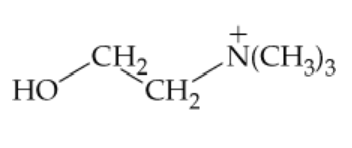
Choline has the following structure. Do you think that this substance reacts with aqueous hydrochloric acid? If so, what is the product? If not, why not?
Chemical structure of choline, showing hydroxyl and quaternary ammonium groups.

Guida verificata passo dopo passo
1
Examine the structure of choline. Choline is an organic compound with a hydroxyl group (-OH) and a quaternary ammonium group (N⁺ with four alkyl groups attached). The quaternary ammonium group is already positively charged and does not have a lone pair of electrons to accept a proton.
Understand the nature of hydrochloric acid (HCl). HCl is a strong acid that dissociates completely in water to produce H⁺ (protons) and Cl⁻ (chloride ions). Acids typically react with bases or substances that can accept protons.
Determine if choline can react with HCl. Since the quaternary ammonium group in choline is already positively charged and cannot accept additional protons, it will not react with HCl. The hydroxyl group (-OH) in choline is not basic enough to react with HCl either.
Conclude that choline does not react with aqueous hydrochloric acid. The structure of choline does not have any functional groups that can interact with H⁺ ions from HCl.
Summarize the reasoning: Choline does not react with aqueous HCl because its quaternary ammonium group is already fully protonated and the hydroxyl group is not reactive under these conditions.

Risposta video verificata per un problema simile:

Questa soluzione video è stata consigliata dai nostri tutor come utile per risolvere questo problema.

Concetti chiave

Ecco i concetti essenziali che devi comprendere per rispondere correttamente alla domanda.

Choline Structure and Properties

Choline is a quaternary ammonium compound with a positively charged nitrogen atom and a hydroxyl group. Its structure includes a hydrocarbon chain, which influences its solubility and reactivity. Understanding its molecular structure is essential to predict how it interacts with acids and other reagents.
Video consigliato:
Percorso guidato
02:54
Physical Properties Concept

Acid-Base Reactions

Acid-base reactions involve the transfer of protons (H+) between substances. In this context, hydrochloric acid (HCl) can donate protons, and choline, being a basic compound due to its nitrogen atom, can accept protons. This interaction is crucial for determining whether a reaction occurs and what products are formed.
Video consigliato:
Percorso guidato
03:08
Acid-Base Reactions Concept 1

Reaction Products

The products of a reaction depend on the reactants' nature and the conditions under which the reaction occurs. In the case of choline and hydrochloric acid, the expected product would be a choline chloride salt, formed by the protonation of choline. Understanding how to predict reaction products is vital for analyzing chemical interactions.
Video consigliato:
Percorso guidato
1:08
Energy Production In Biochemical Pathways Example 1