Ch.16 Amines
McMurry - Fundamentals of General, Organic, and Biological Chemistry 8th Edition
McMurry8th EditionFundamentals of General, Organic, and Biological ChemistryISBN: 9780134015187Non è quello che usi tu?Cambia libro di testo
Capitolo 16, Problema 42a

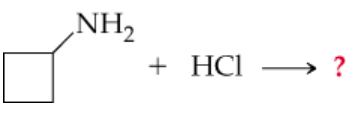
Complete the following equations. (Hint: Remember that a nitrogen with three groups bound to it has a lone pair and one with four does not)
a. Chemical equation showing an amine reacting with hydrochloric acid, with a question mark indicating an incomplete reaction.

Guida verificata passo dopo passo
1
Identify the type of nitrogen atom in the given molecule. Determine whether it has three groups bound to it (indicating a lone pair is present) or four groups (indicating no lone pair). This will help you predict its reactivity and bonding behavior.
Examine the reactants and products in the equation. Consider the role of nitrogen in the reaction, such as whether it is acting as a nucleophile (donating its lone pair) or forming a new bond.
Apply the principles of valence and bonding. For nitrogen, ensure that it follows the octet rule, unless there are exceptions due to resonance or other factors.
Balance the chemical equation by ensuring that the number of atoms of each element is the same on both sides of the equation. Also, check that the charges are balanced if the reaction involves ions.
Review the completed equation to confirm that it adheres to the rules of chemical reactivity and that the nitrogen atom's bonding and lone pair status are consistent with the hints provided.

Risposta video verificata per un problema simile:

Questa soluzione video è stata consigliata dai nostri tutor come utile per risolvere questo problema.

Concetti chiave

Ecco i concetti essenziali che devi comprendere per rispondere correttamente alla domanda.

Valence Shell Electron Pair Repulsion (VSEPR) Theory

VSEPR theory is a model used to predict the geometry of individual molecules based on the repulsion between electron pairs in the valence shell of the central atom. According to this theory, electron pairs will arrange themselves as far apart as possible to minimize repulsion, which helps determine the molecular shape.
Video consigliato:
Percorso guidato
01:04
Valence Shell Electron Pair Repulsion Theory (Simplified) Concept 1

Hybridization

Hybridization is the concept of mixing atomic orbitals to form new hybrid orbitals that can accommodate the bonding requirements of a molecule. For example, sp3 hybridization occurs when one s orbital and three p orbitals mix to form four equivalent sp3 hybrid orbitals, which is common in tetrahedral geometries.
Video consigliato:
Percorso guidato
01:59
Resonance Structures (Simplified) Concept 1

Lone Pairs

Lone pairs are pairs of valence electrons that are not involved in bonding and are localized on a single atom. The presence of lone pairs can significantly influence the geometry of a molecule, as they occupy space and can repel bonding pairs, altering bond angles and overall molecular shape.
Video consigliato:
Percorso guidato
2:56
Base Pairing Concept 1