
Ch.17 Carboxylic Acids and Their Derivatives
McMurry - Fundamentals of General, Organic, and Biological Chemistry 8th Edition
McMurry8th EditionFundamentals of General, Organic, and Biological ChemistryISBN: 9780134015187Non è quello che usi tu?Cambia libro di testo
Capitolo 17, Problema 31b

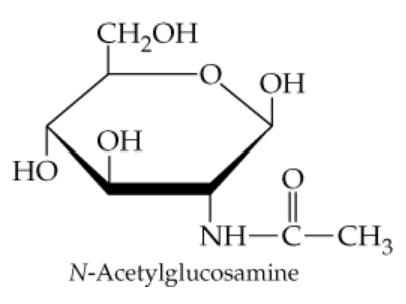
N-Acetylglucosamine (also known as NAG) is an important component on the surfaces of cells.
b. Draw the structures of the products of acid hydrolysis.
Chemical structure of N-Acetylglucosamine, showing its molecular components and functional groups.

Guida verificata passo dopo passo
1
Understand the concept of acid hydrolysis: Acid hydrolysis involves breaking chemical bonds in a molecule using water in the presence of an acid catalyst. For N-Acetylglucosamine (NAG), the hydrolysis will break the glycosidic bond and other susceptible bonds, resulting in smaller molecules.
Identify the structure of N-Acetylglucosamine (NAG): NAG is a monosaccharide derivative of glucose, where an acetyl group (CH₃CO) is attached to the amino group (-NH₂) on the second carbon of the glucose ring.
Determine the bonds that will break during acid hydrolysis: In NAG, the acetyl group attached to the amino group is susceptible to hydrolysis. The reaction will cleave the bond between the acetyl group and the nitrogen atom, resulting in the formation of acetic acid (CH₃COOH) and glucosamine.
Draw the structure of glucosamine: Glucosamine is the product formed after the acetyl group is removed. It is a glucose molecule with an amino group (-NH₂) attached to the second carbon.
Draw the structure of acetic acid: Acetic acid is the byproduct of the hydrolysis reaction. It is a simple carboxylic acid with the formula CH₃COOH. Combine the structures of glucosamine and acetic acid to represent the complete products of the reaction.

Risposta video verificata per un problema simile:

Questa soluzione video è stata consigliata dai nostri tutor come utile per risolvere questo problema.

Concetti chiave

Ecco i concetti essenziali che devi comprendere per rispondere correttamente alla domanda.

N-Acetylglucosamine (NAG)

N-Acetylglucosamine is an amino sugar derived from glucose, characterized by the presence of an acetyl group. It plays a crucial role in the structure of glycoproteins and glycolipids, which are essential for cell recognition and signaling. NAG is also a key component of chitin, found in the exoskeletons of arthropods and the cell walls of fungi.
Video consigliato:
Percorso guidato
00:46
Electronic Structure: Number of Electrons Concept 1

Acid Hydrolysis

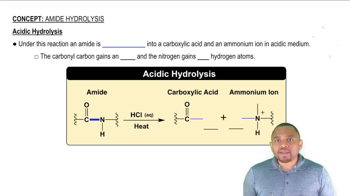
Acid hydrolysis is a chemical reaction where water and an acid are used to break down compounds into their constituent parts. In the case of carbohydrates like NAG, acid hydrolysis cleaves glycosidic bonds, resulting in the release of monosaccharides. This process is essential for understanding how complex carbohydrates are degraded in biological systems.
Video consigliato:
Percorso guidato
1:12
Acidic Hydrolysis Concept 1

Structural Representation

Structural representation refers to the graphical depiction of molecules, showing the arrangement of atoms and the bonds between them. In organic chemistry, drawing structures helps visualize the molecular composition and functional groups, which is critical for predicting reactivity and understanding chemical behavior. Accurate structural representation is vital when illustrating the products of reactions like acid hydrolysis.
Video consigliato:
Percorso guidato
2:08
Molecular Representations Concept 1