Ch.17 Carboxylic Acids and Their Derivatives
McMurry - Fundamentals of General, Organic, and Biological Chemistry 8th Edition
McMurry8th EditionFundamentals of General, Organic, and Biological ChemistryISBN: 9780134015187Non è quello che usi tu?Cambia libro di testo
Capitolo 17, Problema 32a

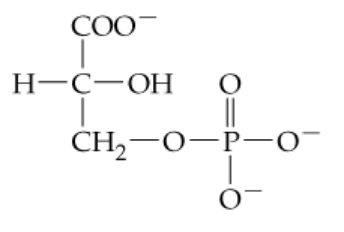
One phosphorylated form of glycerate is 3-phosphoglycerate
Structural representation of 3-phosphoglycerate, showing the linkage between glycerate and phosphate.
a. Identify the type of linkage between glycerate and phosphate.

Guida verificata passo dopo passo
1
Examine the structure of 3-phosphoglycerate, focusing on the connection between the glycerate molecule and the phosphate group.
Identify the functional group on the glycerate molecule where the phosphate group is attached. In this case, the phosphate group is bonded to the hydroxyl (-OH) group on the third carbon of glycerate.
Determine the type of bond formed between the hydroxyl group of glycerate and the phosphate group. This bond is typically a phosphoester bond, which forms when a phosphate group reacts with an alcohol group, releasing water.
Recall that a phosphoester bond is characterized by the linkage: R-O-P(O)_3, where R represents the organic molecule (in this case, glycerate).
Conclude that the type of linkage between glycerate and phosphate in 3-phosphoglycerate is a phosphoester bond, which is a common type of bond in phosphorylated metabolic intermediates.

Risposta video verificata per un problema simile:

Questa soluzione video è stata consigliata dai nostri tutor come utile per risolvere questo problema.

Concetti chiave

Ecco i concetti essenziali che devi comprendere per rispondere correttamente alla domanda.

Phosphate Linkage

The linkage between glycerate and phosphate involves a phosphoester bond, which is formed when a phosphate group is covalently attached to a hydroxyl group of glycerate. This bond is crucial in metabolic pathways, as it allows for the transfer of energy and the regulation of biochemical reactions.
Video consigliato:
Percorso guidato
1:44
Glycosidic Linkage Formation Concept 1

Glycolytic Cycle

The glycolytic cycle is a series of enzymatic reactions that convert glucose into pyruvate, producing ATP and NADH in the process. Understanding this cycle is essential for grasping how intermediates like 3-phosphoglycerate function within cellular metabolism and energy production.
Video consigliato:
Percorso guidato
0:51
The Urea Cycle Concept 3

Metabolic Intermediates

Metabolic intermediates are compounds that form during the metabolic pathways, acting as substrates or products in various biochemical reactions. 3-phosphoglycerate is a key intermediate in glycolysis, highlighting its role in energy metabolism and the importance of understanding its formation and transformation.
Video consigliato:
Percorso guidato
0:52
Metabolic Pathways Concept 2