Ch.18 Amino Acids and Proteins
McMurry - Fundamentals of General, Organic, and Biological Chemistry 8th Edition
McMurry8th EditionFundamentals of General, Organic, and Biological ChemistryISBN: 9780134015187Non è quello che usi tu?Cambia libro di testo
Capitolo 18, Problema 37

Compare and contrast the characteristics of fibrous and globular proteins. Consider biological function, water solubility, amino acid composition, secondary structure, and tertiary structure. Give examples of three fibrous and three globular proteins. (Hint: Make a table.)

Guida verificata passo dopo passo
1
Create a table with two columns: one for fibrous proteins and one for globular proteins. Label the rows with the following categories: biological function, water solubility, amino acid composition, secondary structure, tertiary structure, and examples.
Under 'Biological Function,' note that fibrous proteins typically provide structural support (e.g., collagen in connective tissue), while globular proteins are involved in dynamic functions such as catalysis (enzymes) and transport (e.g., hemoglobin).
Under 'Water Solubility,' indicate that fibrous proteins are generally insoluble in water due to their elongated, hydrophobic structures, whereas globular proteins are soluble in water because of their compact, hydrophilic surfaces.
Under 'Amino Acid Composition,' explain that fibrous proteins often have repetitive amino acid sequences that contribute to their structural roles, while globular proteins have diverse sequences that allow for specific functional sites.
Under 'Secondary and Tertiary Structure,' describe that fibrous proteins primarily exhibit regular secondary structures like α-helices or β-sheets, forming long fibers, while globular proteins have complex tertiary structures with folded, compact shapes. Provide examples: fibrous proteins (collagen, keratin, elastin) and globular proteins (hemoglobin, myoglobin, insulin).

Risposta video verificata per un problema simile:

Questa soluzione video è stata consigliata dai nostri tutor come utile per risolvere questo problema.
Durata del video:
6m

Concetti chiave

Ecco i concetti essenziali che devi comprendere per rispondere correttamente alla domanda.

Fibrous Proteins

Fibrous proteins are elongated, structural proteins that provide support and strength to cells and tissues. They are typically insoluble in water and have a repetitive amino acid sequence, which contributes to their stability and structural roles. Examples include collagen, keratin, and elastin, which are crucial for the integrity of connective tissues, hair, and skin.
Video consigliato:
Percorso guidato
2:01
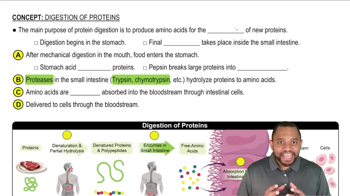
Digestion of Proteins Concept 1

Globular Proteins

Globular proteins are compact, spherical proteins that are generally soluble in water and play a variety of roles in biological processes. Their amino acid composition is more varied than that of fibrous proteins, allowing for diverse functions such as enzymatic activity, transport, and regulation. Examples include hemoglobin, enzymes like amylase, and antibodies, which are essential for oxygen transport, digestion, and immune response, respectively.
Video consigliato:
Percorso guidato
2:01
Digestion of Proteins Concept 1

Protein Structure

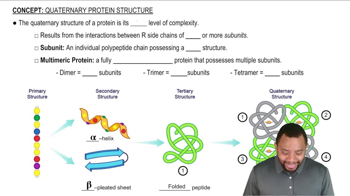
Protein structure is categorized into four levels: primary, secondary, tertiary, and quaternary. The primary structure refers to the linear sequence of amino acids, while secondary structure involves local folding patterns like alpha-helices and beta-sheets. Tertiary structure describes the overall 3D shape of a single polypeptide, and quaternary structure refers to the assembly of multiple polypeptides. Understanding these structures is crucial for comparing fibrous and globular proteins, as their functions are closely tied to their structural characteristics.
Video consigliato:
Percorso guidato
3:26
Quaternary Protein Structure Concept 1
Pratica correlata
Domanda del libro di testo

Threonine has two chiral centers. Draw L-threonine and indicate which carbon atoms are chiral. Which carbon atom is responsible for D and L configuration?

930
views

Domanda del libro di testo

Cell membranes are studded with proteins. Some of these proteins, involved in the transport of molecules across the membrane into the cell, span the entire membrane and are called transmembrane proteins. The interior of the cell membrane is hydrophobic and nonpolar, whereas both the extracellular and intracellular fluids are water-based.

a. List three amino acids you would expect to find in the part of a transmembrane protein that lies within the cell membrane.

852
views
Domanda del libro di testo

Draw the structure of the following amino acids, dipeptides, and tripeptides at low pH (pH 1) and high pH (pH 14). At each pH, assume that all functional groups that might do so are ionized.

e. Gln-Ala-Asn

290
views
Domanda del libro di testo

Draw the hexapeptide Asp-Gly-Phe-Leu-Glu-Ala in linear form showing all of the atoms, and show (using dotted lines) the hydrogen bonding that stabilizes this structure if it is part of an α-helix.

630
views
Domanda del libro di testo

Interactions of amino acids on the interior of proteins are key to the shapes of proteins. In group (a), which pairs of amino acids form hydrophobic interactions? In group (b), which pairs form ionic interactions? Which pairs in group (c) form hydrogen bonds?

a. 1 Pro . . . Phe

   2 Lys . . . Ser

   3 Thr . . . Leu

   4 Ala . . . Gly

132
views
Domanda del libro di testo

Name four biological functions of proteins in the human body, and give an example of a protein for each function.

441
views