Ch.18 Amino Acids and Proteins
McMurry - Fundamentals of General, Organic, and Biological Chemistry 8th Edition
McMurry8th EditionFundamentals of General, Organic, and Biological ChemistryISBN: 9780134015187Non è quello che usi tu?Cambia libro di testo
Capitolo 18, Problema 30b

For each of the conjugated proteins described, identify to which class of conjugated protein it belongs.
b. Ionized zinc is attached to this protein so the protein can function.

Guida verificata passo dopo passo
1
Step 1: Understand the definition of a conjugated protein. A conjugated protein is a protein that is combined with a non-protein component, called a prosthetic group, which is essential for its function.
Step 2: Identify the type of prosthetic group attached to the protein in the problem. In this case, the prosthetic group is ionized zinc.
Step 3: Recall the classification of conjugated proteins based on their prosthetic groups. Proteins with metal ions as their prosthetic group are classified as metalloproteins.
Step 4: Confirm that the protein described in the problem fits the definition of a metalloprotein. Since ionized zinc is a metal ion and is essential for the protein's function, this protein belongs to the metalloprotein class.
Step 5: Conclude that the protein described in the problem is a metalloprotein, as it contains ionized zinc as its prosthetic group.

Risposta video verificata per un problema simile:

Questa soluzione video è stata consigliata dai nostri tutor come utile per risolvere questo problema.

Concetti chiave

Ecco i concetti essenziali che devi comprendere per rispondere correttamente alla domanda.

Conjugated Proteins

Conjugated proteins are complex molecules formed by the combination of a protein with a non-protein component, known as a prosthetic group. These non-protein components can include metal ions, carbohydrates, or lipids, which are essential for the protein's biological function. Understanding the classification of conjugated proteins is crucial for identifying their roles in various biochemical processes.
Video consigliato:
Percorso guidato
2:01
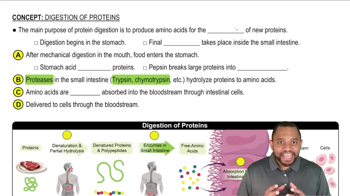
Digestion of Proteins Concept 1

Metal Ions as Prosthetic Groups

Metal ions, such as zinc, can serve as prosthetic groups that are tightly bound to proteins, enabling them to perform specific functions. In the case of zinc, it often plays a critical role in enzyme activity, structural stability, and regulation of biological processes. Recognizing the importance of these metal ions helps in understanding how proteins interact with their environment and catalyze reactions.
Video consigliato:
Percorso guidato
03:23
Polyatomic Ions

Classes of Conjugated Proteins

Conjugated proteins can be classified into several categories based on their prosthetic groups. For instance, metalloproteins contain metal ions, glycoproteins have carbohydrate moieties, and lipoproteins are associated with lipids. Identifying the class of a conjugated protein is essential for understanding its function and the biochemical pathways it participates in.
Video consigliato:
Percorso guidato
2:01
Digestion of Proteins Concept 1