Ch.18 Amino Acids and Proteins
McMurry - Fundamentals of General, Organic, and Biological Chemistry 8th Edition
McMurry8th EditionFundamentals of General, Organic, and Biological ChemistryISBN: 9780134015187Non è quello che usi tu?Cambia libro di testo
Capitolo 18, Problema 24

Consult the β-sheet in Figure 18.2 and (a) name the bonding responsible for the sheet formation and (b) identify the specific atoms responsible for this bonding.

Guida verificata passo dopo passo
1
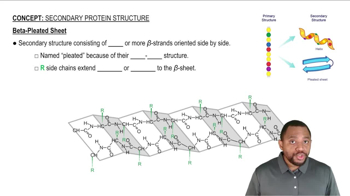
Step 1: Understand the structure of a β-sheet. A β-sheet is a common secondary structure in proteins, formed by the alignment of polypeptide chains in a sheet-like arrangement.
Step 2: Identify the type of bonding responsible for the formation of the β-sheet. The bonding involved is hydrogen bonding, which occurs between the backbone atoms of the polypeptide chains.
Step 3: Recognize the specific atoms involved in the hydrogen bonding. In a β-sheet, the hydrogen bonds form between the carbonyl oxygen (C=O) of one amino acid and the amide hydrogen (N-H) of another amino acid in a neighboring chain.
Step 4: Note the orientation of the β-sheet. The polypeptide chains can be arranged in either a parallel or antiparallel configuration, which affects the alignment of the hydrogen bonds.
Step 5: Summarize the findings. The bonding responsible for β-sheet formation is hydrogen bonding, and the specific atoms involved are the carbonyl oxygen and the amide hydrogen from the peptide backbone.

Risposta video verificata per un problema simile:

Questa soluzione video è stata consigliata dai nostri tutor come utile per risolvere questo problema.

Concetti chiave

Ecco i concetti essenziali che devi comprendere per rispondere correttamente alla domanda.

β-sheet Structure

The β-sheet is a common secondary structure in proteins, characterized by strands of amino acids linked together by hydrogen bonds. These strands can be parallel or antiparallel, influencing the overall stability and properties of the protein. Understanding the arrangement of these strands is crucial for grasping how proteins fold and function.
Video consigliato:
Percorso guidato
2:42
Beta-Pleated Sheet Concept 4

Hydrogen Bonding

Hydrogen bonds are weak interactions that occur when a hydrogen atom covalently bonded to an electronegative atom, like oxygen or nitrogen, is attracted to another electronegative atom. In the context of β-sheets, these bonds form between the carbonyl oxygen of one amino acid and the amide hydrogen of another, stabilizing the sheet structure. This bonding is essential for maintaining the integrity of protein structures.
Video consigliato:
Percorso guidato
1:22
Hydrogenation Reactions Concept 1

Amino Acid Residues

Amino acid residues are the building blocks of proteins, each consisting of an amino group, a carboxyl group, and a unique side chain. In β-sheets, specific atoms from the backbone of these residues, particularly the carbonyl (C=O) and amide (N-H) groups, participate in hydrogen bonding. Identifying these residues is key to understanding the formation and stability of the β-sheet.
Video consigliato:
Percorso guidato
3:03
Amino Acid Catabolism: Amino Group Example 2