Ch.18 Amino Acids and Proteins
McMurry - Fundamentals of General, Organic, and Biological Chemistry 8th Edition
McMurry8th EditionFundamentals of General, Organic, and Biological ChemistryISBN: 9780134015187Non è quello che usi tu?Cambia libro di testo
Capitolo 18, Problema 21

How many ways can four different amino acids be arranged in a peptide so that each peptide is unique?

Guida verificata passo dopo passo
1
Step 1: Recognize that the problem involves arranging four different amino acids in a unique sequence. This is a permutation problem because the order of the amino acids matters.
Step 2: Recall the formula for permutations of n distinct objects, which is given by n! (n factorial). The factorial of a number is the product of all positive integers from 1 to that number.
Step 3: Identify the value of n in this problem. Since there are four different amino acids, n = 4.
Step 4: Write the factorial expression for 4!, which is 4! = 4 × 3 × 2 × 1. This represents the total number of unique arrangements of the four amino acids.
Step 5: Multiply the terms in the factorial expression to determine the total number of unique arrangements. This will give you the final answer.

Risposta video verificata per un problema simile:

Questa soluzione video è stata consigliata dai nostri tutor come utile per risolvere questo problema.

Concetti chiave

Ecco i concetti essenziali che devi comprendere per rispondere correttamente alla domanda.

Permutations

Permutations refer to the different ways in which a set of items can be arranged. In the context of arranging amino acids in a peptide, the order of the amino acids matters, making it a permutation problem. The formula for permutations of 'n' distinct items is n!, which represents the product of all positive integers up to 'n'.

Amino Acids

Amino acids are organic compounds that serve as the building blocks of proteins. Each amino acid has a unique side chain, which determines its properties and role in protein structure. In this question, the focus is on four different amino acids, emphasizing their distinctiveness in forming unique peptides.
Video consigliato:
Percorso guidato
3:03
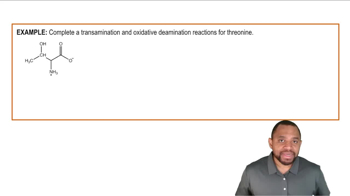
Amino Acid Catabolism: Amino Group Example 2

Peptide Formation

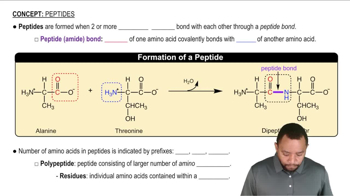
Peptides are short chains of amino acids linked by peptide bonds. The arrangement of amino acids in a peptide influences its structure and function. Understanding how different sequences of amino acids lead to unique peptides is crucial for grasping the significance of permutations in this context.
Video consigliato:
Percorso guidato
3:07
Peptides Concept 1