Ch.18 Amino Acids and Proteins
McMurry - Fundamentals of General, Organic, and Biological Chemistry 8th Edition
McMurry8th EditionFundamentals of General, Organic, and Biological ChemistryISBN: 9780134015187Non è quello che usi tu?Cambia libro di testo
Capitolo 18, Problema 8

Which amino acid is hydrophilic (dissolves in aqueous solutions)? Why?
a. isoleucine
b. phenylalanine
c. aspartic acid

Guida verificata passo dopo passo
1
Identify the chemical properties of each amino acid listed in the options. Amino acids can be classified as hydrophilic (water-loving) or hydrophobic (water-fearing) based on the nature of their side chains (R groups).
Examine isoleucine: Isoleucine has a nonpolar, aliphatic side chain. Nonpolar side chains are hydrophobic because they do not interact well with water molecules.
Examine phenylalanine: Phenylalanine has a nonpolar, aromatic side chain. Aromatic side chains are generally hydrophobic because they lack polar groups that can form hydrogen bonds with water.
Examine aspartic acid: Aspartic acid has a polar, negatively charged side chain due to the presence of a carboxylate group (-COO⁻). Charged and polar side chains are hydrophilic because they can form hydrogen bonds and interact with water molecules.
Conclude that aspartic acid is hydrophilic because its negatively charged side chain allows it to dissolve in aqueous solutions, while isoleucine and phenylalanine are hydrophobic due to their nonpolar side chains.

Risposta video verificata per un problema simile:

Questa soluzione video è stata consigliata dai nostri tutor come utile per risolvere questo problema.

Concetti chiave

Ecco i concetti essenziali che devi comprendere per rispondere correttamente alla domanda.

Hydrophilicity

Hydrophilicity refers to the property of a molecule that allows it to interact favorably with water. Hydrophilic substances tend to be polar or charged, enabling them to form hydrogen bonds with water molecules, which facilitates their dissolution in aqueous solutions. This property is crucial in biological systems, as it influences the solubility and transport of molecules within cells.
Video consigliato:
Percorso guidato
2:00
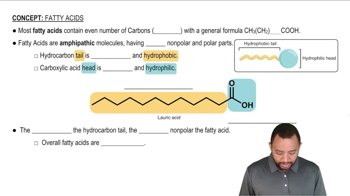
Fatty Acids Concept 1

Amino Acid Structure

Amino acids are organic compounds that serve as the building blocks of proteins. Each amino acid consists of a central carbon atom, an amino group, a carboxyl group, a hydrogen atom, and a variable side chain (R group) that determines its properties. The nature of the side chain influences whether the amino acid is hydrophilic or hydrophobic, impacting protein structure and function.
Video consigliato:
Percorso guidato
3:03
Amino Acid Catabolism: Amino Group Example 2

Polar vs. Nonpolar Side Chains

Amino acids can be classified based on the characteristics of their side chains as polar (hydrophilic) or nonpolar (hydrophobic). Polar side chains contain functional groups that can form hydrogen bonds with water, making them soluble in aqueous environments. In contrast, nonpolar side chains are hydrophobic and tend to aggregate away from water, which is essential for the folding and stability of proteins.
Video consigliato:
Percorso guidato
01:34
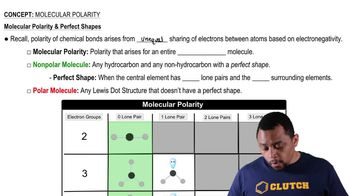
Molecular Polarity (Simplified) Concept 1