Ch.18 Amino Acids and Proteins
McMurry - Fundamentals of General, Organic, and Biological Chemistry 8th Edition
McMurry8th EditionFundamentals of General, Organic, and Biological ChemistryISBN: 9780134015187Non è quello che usi tu?Cambia libro di testo
Capitolo 18, Problema 6

Using Table 18.3, name the α-amino acids that (a) contain an aromatic ring, (b) contain sulfur, (c) are alcohols, and (d) have alkyl-group side chains.

Guida verificata passo dopo passo
1
Step 1: Understand the problem. The question asks us to identify α-amino acids based on specific structural features: (a) aromatic rings, (b) sulfur atoms, (c) alcohol groups, and (d) alkyl-group side chains. Refer to Table 18.3 for the list of amino acids and their structures.
Step 2: For part (a), identify amino acids with aromatic rings. Aromatic rings are cyclic structures with alternating double bonds (e.g., benzene). Look for amino acids like phenylalanine, tyrosine, and tryptophan, which contain aromatic groups in their side chains.
Step 3: For part (b), identify amino acids containing sulfur. Sulfur is present in the side chains of amino acids like cysteine (–SH group) and methionine (–S– group).
Step 4: For part (c), identify amino acids that are alcohols. Alcohol groups are characterized by the –OH functional group. Amino acids like serine and threonine have –OH groups in their side chains.
Step 5: For part (d), identify amino acids with alkyl-group side chains. Alkyl groups are simple hydrocarbon chains or branches. Examples include glycine (H side chain), alanine (–CH₃), valine, leucine, and isoleucine, which all have alkyl groups in their side chains.

Risposta video verificata per un problema simile:

Questa soluzione video è stata consigliata dai nostri tutor come utile per risolvere questo problema.

Concetti chiave

Ecco i concetti essenziali che devi comprendere per rispondere correttamente alla domanda.

Amino Acid Structure

Amino acids are organic compounds that serve as the building blocks of proteins. Each amino acid has a central carbon atom bonded to an amino group, a carboxyl group, a hydrogen atom, and a variable side chain (R group) that determines its properties. Understanding the structure of amino acids is essential for identifying their classifications based on functional groups.
Video consigliato:
Percorso guidato
3:03
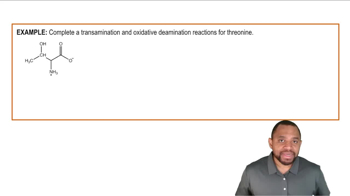
Amino Acid Catabolism: Amino Group Example 2

Functional Groups in Amino Acids

Functional groups are specific groups of atoms within molecules that are responsible for the characteristic chemical reactions of those molecules. In amino acids, common functional groups include hydroxyl (-OH) for alcohols, thiol (-SH) for sulfur-containing amino acids, and aromatic rings for those with aromatic properties. Recognizing these groups helps in categorizing amino acids based on their side chains.
Video consigliato:
Percorso guidato
2:21
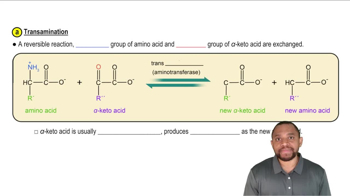
Amino Acid Catabolism: Amino Group Concept 2

Classification of Amino Acids

Amino acids can be classified based on the properties of their side chains into categories such as nonpolar, polar, aromatic, and sulfur-containing. This classification is crucial for understanding their roles in protein structure and function. For example, aromatic amino acids like phenylalanine have unique properties due to their ring structure, while sulfur-containing amino acids like cysteine play important roles in protein stability.
Video consigliato:
Percorso guidato
1:33
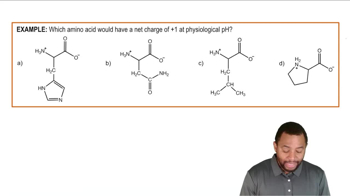
Amino Acid Classifications Example 3