Ch.19 Enzymes and Vitamins
McMurry - Fundamentals of General, Organic, and Biological Chemistry 8th Edition
McMurry8th EditionFundamentals of General, Organic, and Biological ChemistryISBN: 9780134015187Non è quello che usi tu?Cambia libro di testo
Capitolo 19, Problema 71

Activation of a zymogen is by covalent modification. How might phosphorylation or dephosphorylation (also covalent modification) modify an enzyme to make it more active (or more inactive)?

Guida verificata passo dopo passo
1
Understand that zymogens are inactive enzyme precursors that require a biochemical change to become active.
Recognize that covalent modification, such as phosphorylation or dephosphorylation, involves the addition or removal of a phosphate group to an enzyme.
Phosphorylation typically involves the addition of a phosphate group from ATP to an amino acid residue (like serine, threonine, or tyrosine) on the enzyme, which can cause a conformational change.
This conformational change can either activate or deactivate the enzyme by altering its active site or its interaction with other molecules.
Dephosphorylation, the removal of a phosphate group, can reverse these changes, potentially restoring the enzyme to its original state or altering its activity further.

Risposta video verificata per un problema simile:

Questa soluzione video è stata consigliata dai nostri tutor come utile per risolvere questo problema.
Durata del video:
4m

Concetti chiave

Ecco i concetti essenziali che devi comprendere per rispondere correttamente alla domanda.

Zymogen Activation

Zymogens are inactive enzyme precursors that require a biochemical change to become active. This activation often involves covalent modifications, such as cleavage of specific peptide bonds, which alters the zymogen's structure and allows it to catalyze reactions. Understanding this process is crucial for grasping how enzymes are regulated in biological systems.
Video consigliato:
Percorso guidato
2:21
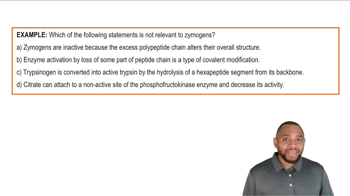
Zymogens Example 1

Phosphorylation and Dephosphorylation

Phosphorylation is the addition of a phosphate group to a molecule, typically a protein, which can alter its function and activity. Conversely, dephosphorylation is the removal of a phosphate group. These processes are key regulatory mechanisms in cellular signaling and can either activate or inhibit enzyme activity, depending on the specific enzyme and context.
Video consigliato:
Percorso guidato
0:51
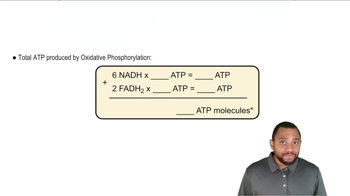
Oxidative Phosphorylation Concept 2

Enzyme Regulation

Enzyme regulation refers to the various mechanisms that control enzyme activity and function within a cell. This includes allosteric regulation, covalent modifications like phosphorylation, and feedback inhibition. Understanding these regulatory mechanisms is essential for comprehending how metabolic pathways are controlled and how cells respond to changes in their environment.
Video consigliato:
Percorso guidato
2:14
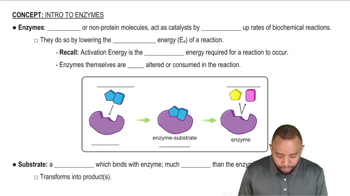
Intro to Enzymes Concept 1