Ch.19 Enzymes and Vitamins
McMurry - Fundamentals of General, Organic, and Biological Chemistry 8th Edition
McMurry8th EditionFundamentals of General, Organic, and Biological ChemistryISBN: 9780134015187Non è quello che usi tu?Cambia libro di testo
Capitolo 19, Problema 75

What is the relationship between vitamins and enzymes?

Guida verificata passo dopo passo
1
Understand that enzymes are biological catalysts that speed up chemical reactions in the body, and they often require additional molecules to function properly.
Learn that vitamins are organic compounds that the body needs in small amounts for various functions, including acting as precursors to coenzymes.
Recognize that coenzymes are non-protein molecules that bind to enzymes and assist in catalyzing reactions. Many coenzymes are derived from vitamins. For example, vitamin B3 (niacin) is a precursor to NAD⁺, a coenzyme involved in redox reactions.
Explore the specific role of vitamins in enzyme activity. Without the necessary vitamin-derived coenzyme, the enzyme may not function effectively, leading to metabolic issues.
Conclude that the relationship between vitamins and enzymes is that vitamins often serve as precursors to coenzymes, which are essential for the proper functioning of enzymes in biochemical reactions.

Risposta video verificata per un problema simile:

Questa soluzione video è stata consigliata dai nostri tutor come utile per risolvere questo problema.
Durata del video:
1m

Concetti chiave

Ecco i concetti essenziali che devi comprendere per rispondere correttamente alla domanda.

Vitamins

Vitamins are organic compounds that are essential for normal growth and metabolism in living organisms. They play crucial roles in various biochemical processes, often acting as coenzymes or precursors for enzyme function. Vitamins cannot be synthesized in sufficient quantities by the body and must be obtained through diet.
Video consigliato:
Percorso guidato
1:10
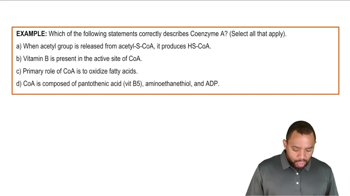
Coenzyme A Example 4

Enzymes

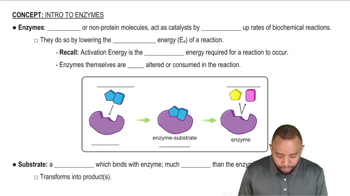
Enzymes are biological catalysts that speed up chemical reactions in the body without being consumed in the process. They are typically proteins that lower the activation energy required for reactions, allowing metabolic processes to occur efficiently. Enzymes often require specific cofactors, which can include vitamins, to function properly.
Video consigliato:
Percorso guidato
2:14
Intro to Enzymes Concept 1

Cofactors

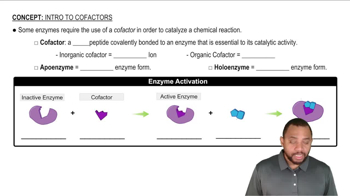
Cofactors are non-protein chemical compounds that assist enzymes in catalyzing reactions. They can be metal ions or organic molecules, such as vitamins, that bind to the enzyme and are necessary for its activity. The presence of vitamins as cofactors is vital for many enzymatic reactions, highlighting the interconnectedness of vitamins and enzymes in metabolic pathways.
Video consigliato:
Percorso guidato
2:39
Intro to Cofactors Concept 1