Ch.19 Enzymes and Vitamins
McMurry - Fundamentals of General, Organic, and Biological Chemistry 8th Edition
McMurry8th EditionFundamentals of General, Organic, and Biological ChemistryISBN: 9780134015187Non è quello che usi tu?Cambia libro di testo
Capitolo 19, Problema 25a

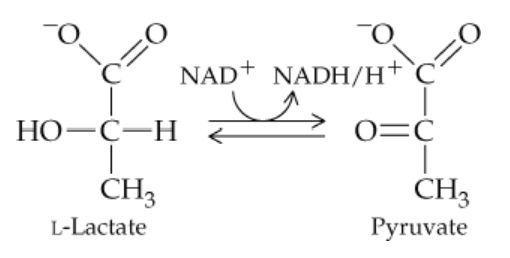
Answer questions (a)–(e) concerning the following reaction:
Chemical reaction diagram showing the conversion between L-Lactate and Pyruvate with NAD+ and NADH/H+ involvement.
a. The enzyme involved in this reaction belongs to what class of enzymes?

Guida verificata passo dopo passo
1
Identify the type of reaction occurring in the given chemical equation. Enzyme classes are categorized based on the type of reaction they catalyze, such as oxidation-reduction, hydrolysis, or isomerization.
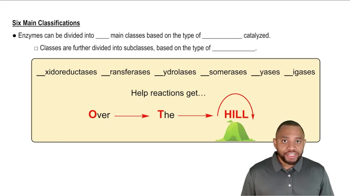
Review the six main classes of enzymes: oxidoreductases, transferases, hydrolases, lyases, isomerases, and ligases. Each class corresponds to a specific type of reaction.
Analyze the reaction provided in the problem (e.g., does it involve the transfer of electrons, breaking of bonds with water, or rearrangement of atoms within a molecule?).
Match the observed reaction type to the appropriate enzyme class. For example, if the reaction involves the addition or removal of water, the enzyme is likely a hydrolase.
Conclude the enzyme class based on the reaction's characteristics and provide reasoning for the classification.

Risposta video verificata per un problema simile:

Questa soluzione video è stata consigliata dai nostri tutor come utile per risolvere questo problema.
Durata del video:
41s

Concetti chiave

Ecco i concetti essenziali che devi comprendere per rispondere correttamente alla domanda.

Enzyme Classification

Enzymes are classified into six main categories based on the type of reaction they catalyze: oxidoreductases, transferases, hydrolases, lyases, isomerases, and ligases. Understanding the specific class of an enzyme helps in identifying its function and the biochemical processes it facilitates.
Video consigliato:
Percorso guidato
1:26
Six Main Classifications Concept 3

Enzyme Function

Enzymes are biological catalysts that speed up chemical reactions in living organisms by lowering the activation energy required. Each enzyme has a specific substrate it acts upon, and its activity can be influenced by factors such as temperature, pH, and the presence of inhibitors or activators.
Video consigliato:
Percorso guidato
02:16
Logarithmic Functions

Reaction Mechanism

The reaction mechanism describes the step-by-step process by which an enzyme converts substrates into products. This includes the formation of enzyme-substrate complexes and the transition states, which are crucial for understanding how enzymes achieve their catalytic effects and the overall kinetics of the reaction.
Video consigliato:
Percorso guidato
1:30
Alcohol Reactions: Dehydration Reactions Concept 1