Ch.19 Enzymes and Vitamins
McMurry - Fundamentals of General, Organic, and Biological Chemistry 8th Edition
McMurry8th EditionFundamentals of General, Organic, and Biological ChemistryISBN: 9780134015187Non è quello che usi tu?Cambia libro di testo
Capitolo 19, Problema 39c

Name an enzyme that acts on each molecule.
c. RNA

Guida verificata passo dopo passo
1
Understand that enzymes are biological catalysts that speed up chemical reactions by acting on specific substrates. In this case, the substrate is RNA.
Recall that enzymes are named based on the type of reaction they catalyze or the substrate they act upon. For RNA, the enzyme typically involved is one that breaks down or modifies RNA molecules.
Identify that enzymes ending in '-ase' often indicate their function. For RNA, the enzyme responsible for breaking it down is called ribonuclease (commonly abbreviated as RNase).
Note that ribonucleases catalyze the hydrolysis of the phosphodiester bonds in RNA, breaking it into smaller components such as nucleotides.
Conclude that ribonuclease (RNase) is the enzyme that acts on RNA, facilitating its degradation or processing in biological systems.

Risposta video verificata per un problema simile:

Questa soluzione video è stata consigliata dai nostri tutor come utile per risolvere questo problema.
Durata del video:
1m

Concetti chiave

Ecco i concetti essenziali che devi comprendere per rispondere correttamente alla domanda.

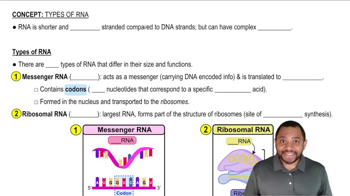
RNA

Ribonucleic acid (RNA) is a crucial molecule in the biology of cells, playing a central role in coding, decoding, regulation, and expression of genes. Unlike DNA, RNA is typically single-stranded and contains ribose sugar and the nitrogenous base uracil instead of thymine. RNA is involved in various cellular processes, including protein synthesis and gene regulation.
Video consigliato:
Percorso guidato
2:43
Types of RNA Concept 1

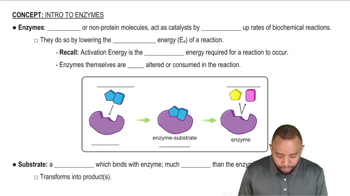
Enzymes

Enzymes are biological catalysts that accelerate chemical reactions in living organisms. They are typically proteins that lower the activation energy required for reactions, thus increasing the rate at which they occur. Each enzyme is specific to a particular substrate, meaning it acts on a specific molecule or type of molecule, facilitating various biochemical processes.
Video consigliato:
Percorso guidato
2:14
Intro to Enzymes Concept 1

RNA Polymerase

RNA polymerase is the enzyme responsible for synthesizing RNA from a DNA template during the process of transcription. It binds to the promoter region of a gene and unwinds the DNA strands, allowing it to read the sequence and construct a complementary RNA strand. This enzyme is essential for gene expression and the production of messenger RNA (mRNA), which carries genetic information to ribosomes for protein synthesis.
Video consigliato:
Percorso guidato
2:43
Types of RNA Concept 1