Ch.19 Enzymes and Vitamins
McMurry - Fundamentals of General, Organic, and Biological Chemistry 8th Edition
McMurry8th EditionFundamentals of General, Organic, and Biological ChemistryISBN: 9780134015187Non è quello che usi tu?Cambia libro di testo
Capitolo 19, Problema 44c

What kind of reaction does each of these enzymes catalyze?
c. A reductase

Guida verificata passo dopo passo
1
Understand the role of enzymes: Enzymes are biological catalysts that speed up chemical reactions in living organisms. Each enzyme is specific to a particular type of reaction.
Identify the suffix '-ase': Enzymes are often named based on the type of reaction they catalyze, with the suffix '-ase' indicating an enzyme.
Focus on the term 'reductase': The prefix 'reduct-' refers to reduction, which is a chemical process involving the gain of electrons or a decrease in oxidation state of a molecule.
Determine the type of reaction: A reductase enzyme catalyzes reduction reactions, often by transferring electrons from a donor molecule (such as NADH or FADH2) to the substrate being reduced.
Conclude the function: Reductase enzymes are essential in various biochemical pathways, such as cellular respiration and biosynthesis, where they facilitate the reduction of specific molecules.

Risposta video verificata per un problema simile:

Questa soluzione video è stata consigliata dai nostri tutor come utile per risolvere questo problema.
Durata del video:
1m

Concetti chiave

Ecco i concetti essenziali che devi comprendere per rispondere correttamente alla domanda.

Enzymatic Reactions

Enzymatic reactions are biochemical processes facilitated by enzymes, which are proteins that act as catalysts. They lower the activation energy required for a reaction, allowing it to proceed more quickly and efficiently. Understanding the type of reaction an enzyme catalyzes is crucial for grasping its biological function and role in metabolic pathways.
Video consigliato:
Percorso guidato
3:09
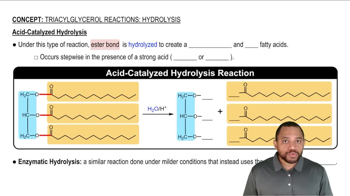
Triacylglycerol Reactions: Hydrolysis Concept 1

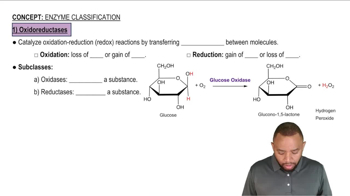
Reductase

A reductase is a specific type of enzyme that catalyzes reduction reactions, where electrons are added to a substrate. This process often involves the transfer of hydrogen atoms or the addition of electrons, leading to the conversion of oxidized substrates into their reduced forms. Reductases play vital roles in various biological processes, including metabolism and cellular respiration.
Video consigliato:
Percorso guidato
2:43
Oxidoreductases Concept 4

Oxidation-Reduction Reactions

Oxidation-reduction (redox) reactions are chemical reactions that involve the transfer of electrons between two substances. In these reactions, one substance is oxidized (loses electrons) while the other is reduced (gains electrons). Understanding redox reactions is essential for comprehending how reductases function, as they are integral to many metabolic pathways and energy production in cells.
Video consigliato:
Percorso guidato
2:38
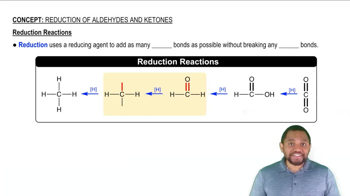
Reduction Reactions Concept 1