
Ch.19 Enzymes and Vitamins
McMurry - Fundamentals of General, Organic, and Biological Chemistry 8th Edition
McMurry8th EditionFundamentals of General, Organic, and Biological ChemistryISBN: 9780134015187Non è quello che usi tu?Cambia libro di testo
Capitolo 19, Problema 58b

The text discusses three forms of enzyme inhibition: uncompetitive inhibition, competitive inhibition, and irreversible inhibition.
b. What kinds of bonds are formed between an enzyme and each of these three kinds of inhibitors?

Guida verificata passo dopo passo
1
Understand the three types of enzyme inhibition: Competitive inhibition occurs when an inhibitor competes with the substrate for the active site of the enzyme. Uncompetitive inhibition occurs when the inhibitor binds only to the enzyme-substrate complex. Irreversible inhibition involves the permanent inactivation of the enzyme by the inhibitor.
For competitive inhibition, the bonds formed between the enzyme and the inhibitor are typically weak, non-covalent interactions such as hydrogen bonds, ionic bonds, or van der Waals forces. These interactions are reversible.
For uncompetitive inhibition, the inhibitor binds to the enzyme-substrate complex, often forming non-covalent bonds such as hydrogen bonds or ionic interactions. These bonds are also reversible.
For irreversible inhibition, the inhibitor forms strong covalent bonds with the enzyme, permanently inactivating it. This type of inhibition is not reversible under normal physiological conditions.
Summarize the bond types: Competitive and uncompetitive inhibitors form reversible, non-covalent bonds, while irreversible inhibitors form strong, covalent bonds with the enzyme.

Risposta video verificata per un problema simile:

Questa soluzione video è stata consigliata dai nostri tutor come utile per risolvere questo problema.
Durata del video:
4m

Concetti chiave

Ecco i concetti essenziali che devi comprendere per rispondere correttamente alla domanda.

Uncompetitive Inhibition

Uncompetitive inhibition occurs when an inhibitor binds to the enzyme-substrate complex, preventing the complex from releasing products. This type of inhibition typically involves non-covalent interactions, such as hydrogen bonds and van der Waals forces, which stabilize the inhibitor's binding to the enzyme-substrate complex.
Video consigliato:
Percorso guidato
1:19
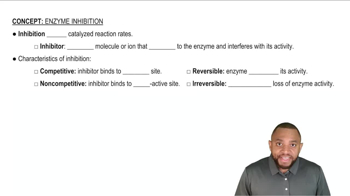
Enzyme Inhibition Concept 1

Competitive Inhibition

Competitive inhibition happens when an inhibitor competes with the substrate for binding to the active site of the enzyme. The bonds formed in this case are usually non-covalent, including hydrogen bonds and ionic interactions, allowing the inhibitor to temporarily occupy the active site and block substrate access.
Video consigliato:
Percorso guidato
1:19
Enzyme Inhibition Concept 1

Irreversible Inhibition

Irreversible inhibition involves the formation of a stable, covalent bond between the inhibitor and the enzyme, permanently inactivating the enzyme. This type of inhibition often modifies key amino acid residues in the active site, leading to a long-lasting effect on enzyme activity.
Video consigliato:
Percorso guidato
1:19
Enzyme Inhibition Concept 1
Pratica correlata
Domanda del libro di testo

What general effects would you expect the following changes to have on the rate of an enzyme-catalyzed reaction for an enzyme that has its maximum activity at body temperature (about 37°C)?

c. Adding an organic solvent, such as methanol

797
views
Domanda del libro di testo

One mechanism by which lead exerts its poisonous effect on enzymes can be stopped by chelation therapy with EDTA. Describe this type of lead poisoning and explain why it is reversible.

1460
views
Domanda del libro di testo

What kind of inhibition (uncompetitive, competitive, or irreversible) is present in each of the following:

c. The antibiotic deoxycycline inhibits the bacterial enzyme collagenase, slowing bacterial growth. Deoxycycline does not fit into the active site of collagenase and binds elsewhere on the enzyme.

1673
views
Domanda del libro di testo

What kind of inhibition (uncompetitive, competitive, or irreversible) is present in each of the following:

a. Penicillin is used to treat certain bacterial infections. Penicillin is effective because it binds to the enzyme glycopeptide transpeptidase and does not dissociate.

1195
views
Domanda del libro di testo

What general effects would you expect the following changes to have on the rate of an enzyme-catalyzed reaction for an enzyme that has its maximum activity at body temperature (about 37°C)?

c. Adding an oxidizing agent, such as hydrogen peroxide

723
views
Domanda del libro di testo

What general effects would you expect the following changes to have on the rate of an enzyme-catalyzed reaction for an enzyme that has its maximum activity at body temperature (about 37°C)?

a. Raising the temperature from 37°C to 70°C

827
views