Ch.20 Carbohydrates
McMurry - Fundamentals of General, Organic, and Biological Chemistry 8th Edition
McMurry8th EditionFundamentals of General, Organic, and Biological ChemistryISBN: 9780134015187Non è quello che usi tu?Cambia libro di testo
Capitolo 20, Problema 63

How are amylose and amylopectin similar to each other, and how are they different from each other?

Guida verificata passo dopo passo
1
Amylose and amylopectin are both polysaccharides composed of glucose monomers, making them similar in their basic building blocks and their role as energy storage molecules in plants.
Both amylose and amylopectin are components of starch, with amylose being the linear (unbranched) polymer and amylopectin being the branched polymer.
Amylose consists of glucose units linked by α(1→4) glycosidic bonds, forming a helical structure, while amylopectin contains both α(1→4) glycosidic bonds for the linear chains and α(1→6) glycosidic bonds at the branch points.
Amylopectin is more highly branched than amylose, which makes it more soluble in water and allows for quicker enzymatic breakdown during digestion compared to amylose.
The structural differences between amylose and amylopectin influence their physical properties, such as their ability to form gels and their digestibility, with amylose forming firmer gels and being digested more slowly.

Risposta video verificata per un problema simile:

Questa soluzione video è stata consigliata dai nostri tutor come utile per risolvere questo problema.
Durata del video:
4m

Concetti chiave

Ecco i concetti essenziali che devi comprendere per rispondere correttamente alla domanda.

Amylose

Amylose is a linear polymer made up of glucose units linked by α(1→4) glycosidic bonds. It typically forms a helical structure and is less soluble in water compared to amylopectin. Amylose constitutes about 20-30% of starch and is important for energy storage in plants.
Video consigliato:
Percorso guidato
0:50
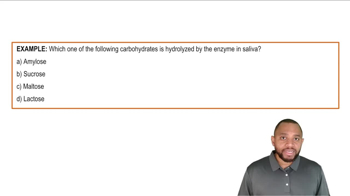
Intro To Carbohydrate Metabolism Example 1

Amylopectin

Amylopectin is a branched polymer of glucose, consisting of α(1→4) glycosidic bonds along with α(1→6) bonds at the branching points. It is more soluble in water than amylose and makes up about 70-80% of starch. The branched structure allows for quicker enzymatic breakdown, providing rapid energy release.
Video consigliato:
Percorso guidato
1:24
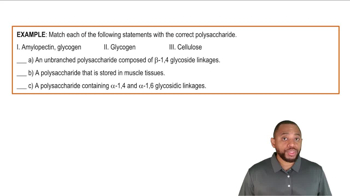
Polysaccharides Example 1

Starch Structure and Function

Starch is a polysaccharide composed of amylose and amylopectin, serving as a primary energy storage molecule in plants. The ratio of amylose to amylopectin affects the physical properties of starch, such as its digestibility and gelatinization. Understanding these differences is crucial for applications in food science and nutrition.
Video consigliato:
Percorso guidato
02:16
Logarithmic Functions