D-Fructose can form a six-membered cyclic hemiacetal as well as the more prevalent five-membered cyclic form. Draw the α isomer of D-fructose in the six-membered ring.
Ch.20 Carbohydrates
McMurry8th EditionFundamentals of General, Organic, and Biological ChemistryISBN: 9780134015187Non è quello che usi tu?Cambia libro di testo
Capitolo 20, Problema 75
Are the α and β forms of the disaccharide lactose enantiomers of each other? Why or why not?
Guida verificata passo dopo passo1
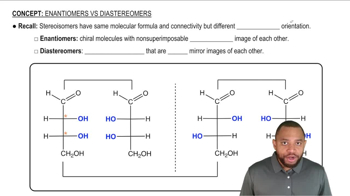
Understand the terms: Enantiomers are stereoisomers that are non-superimposable mirror images of each other. They differ in the arrangement of atoms around a chiral center and have opposite configurations at all chiral centers.
Recall the structure of lactose: Lactose is a disaccharide composed of one molecule of galactose and one molecule of glucose linked by a β-1,4-glycosidic bond. The α and β forms of lactose differ in the configuration of the anomeric carbon of the glucose unit.
Analyze the α and β forms: The α form has the hydroxyl group on the anomeric carbon of the glucose unit pointing down (opposite to the CH₂OH group), while the β form has the hydroxyl group pointing up (same side as the CH₂OH group).
Determine if they are enantiomers: For two molecules to be enantiomers, they must be mirror images of each other and differ at all chiral centers. The α and β forms of lactose differ only at the anomeric carbon of the glucose unit, not at all chiral centers.
Conclude: Since the α and β forms of lactose are not mirror images and differ only at one chiral center, they are not enantiomers. Instead, they are anomers, a specific type of diastereomer that differs at the anomeric carbon.

Risposta video verificata per un problema simile:
Questa soluzione video è stata consigliata dai nostri tutor come utile per risolvere questo problema.
Durata del video:
3mConcetti chiave
Ecco i concetti essenziali che devi comprendere per rispondere correttamente alla domanda.
Enantiomers
Enantiomers are a type of stereoisomer that are non-superimposable mirror images of each other. They typically arise in molecules that contain one or more chiral centers, where the arrangement of atoms around the chiral center leads to two distinct configurations. Understanding enantiomers is crucial for determining the optical activity and biological interactions of compounds.
Video consigliato:
Percorso guidato
Enantiomers vs Diastereomers Concept 1
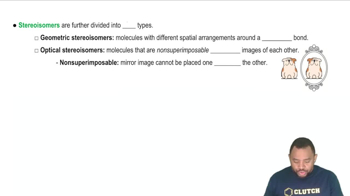
Stereoisomerism
Stereoisomerism refers to the phenomenon where molecules have the same molecular formula and connectivity of atoms but differ in the spatial arrangement of those atoms. This can lead to different physical and chemical properties, including reactivity and interaction with biological systems. Stereoisomers can be further classified into enantiomers and diastereomers.
Video consigliato:
Percorso guidato
Stereoisomers Concept 2
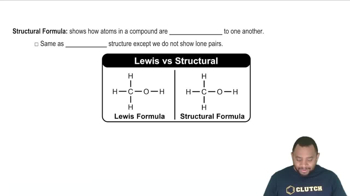
Lactose Structure
Lactose is a disaccharide composed of two monosaccharides: glucose and galactose. The α and ß forms of lactose differ in the configuration around the anomeric carbon of the glucose unit, which affects their properties and interactions. Understanding the structural differences between these forms is essential for determining whether they are enantiomers or not.
Video consigliato:
Percorso guidato
Structural Formula Concept 2
Pratica correlata
Domanda del libro di testo
531
views
Domanda del libro di testo
Describe the differences between mono-, di-, and polysaccharides.
1622
views
Domanda del libro di testo
Amylose (a form of starch) and cellulose are both polymers of glucose. What is the main structural difference between them? What roles do these two polymers have in nature?
574
views
Domanda del libro di testo
Trehalose, a disaccharide found in the blood of insects, has the following structure. What simple sugars would you obtain on hydrolysis of trehalose? (Hint: Rotate one of the rings in your head or redraw it rotated.)
1117
views
Domanda del libro di testo
How are amylose and amylopectin similar to each other, and how are they different from each other?
595
views
Domanda del libro di testo
Name a naturally occurring carbohydrate and its source for each type of carbohydrate listed in Problem 20.83.
666
views