Ch.20 Carbohydrates
McMurry - Fundamentals of General, Organic, and Biological Chemistry 8th Edition
McMurry8th EditionFundamentals of General, Organic, and Biological ChemistryISBN: 9780134015187Non è quello che usi tu?Cambia libro di testo
Capitolo 20, Problema 13d

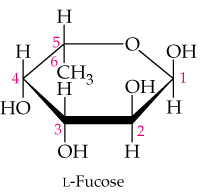
L-Fucose is one of the naturally occurring L monosaccharides. It is present in the short chains of monosaccharides by which blood groups are classified. Compare the structure of L-fucose shown in the margin with the structures of α- and β-D-galactose and answer the following questions.
d. "Fucose” is a common name. Is 6-deoxy-L-galactose a correct name for fucose? Why or why not?
Structural diagram of l-Fucose, a monosaccharide, with labeled carbon atoms and hydroxyl groups.

Guida verificata passo dopo passo
1
Step 1: Understand the structure of l-fucose. l-Fucose is a naturally occurring l-monosaccharide, and its structure includes a six-carbon backbone with a hydroxyl group (-OH) on the second carbon and a methyl group (-CH3) replacing the hydroxyl group on the sixth carbon. This makes it a 6-deoxy sugar (a sugar missing an oxygen atom at the sixth carbon).
Step 2: Compare l-fucose to d-galactose. d-Galactose is a six-carbon aldose sugar with hydroxyl groups attached to carbons 2, 3, 4, and 5 in specific stereochemical orientations. To determine if l-fucose can be named as 6-deoxy-l-galactose, we need to compare the stereochemistry of the two molecules at each chiral center.
Step 3: Analyze the stereochemistry of l-fucose. l-Fucose has the same stereochemistry as l-galactose at carbons 2, 3, and 4. However, the sixth carbon in l-fucose is a methyl group (-CH3) instead of a hydroxymethyl group (-CH2OH), which is consistent with the '6-deoxy' designation.
Step 4: Verify the naming convention. The name '6-deoxy-l-galactose' is correct for l-fucose because it accurately describes the structure: it is derived from l-galactose by replacing the hydroxyl group on the sixth carbon with a hydrogen atom, forming a methyl group.
Step 5: Conclude the reasoning. The name '6-deoxy-l-galactose' is appropriate for l-fucose because it reflects both the stereochemistry and the structural modification (loss of oxygen at the sixth carbon) relative to l-galactose.

Risposta video verificata per un problema simile:

Questa soluzione video è stata consigliata dai nostri tutor come utile per risolvere questo problema.
Durata del video:
3m

Concetti chiave

Ecco i concetti essenziali che devi comprendere per rispondere correttamente alla domanda.

Monosaccharide Structure

Monosaccharides are the simplest form of carbohydrates, consisting of single sugar units. They can vary in structure based on the arrangement of carbon, hydrogen, and oxygen atoms. Understanding the structural differences between monosaccharides, such as l-fucose and d-galactose, is crucial for comparing their properties and functions, particularly in biological contexts like blood group classification.
Video consigliato:
Percorso guidato
2:49
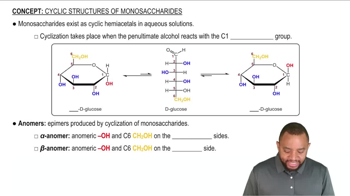
Cyclic Structures of Monosaccharides Concept 1

Deoxy Sugars

Deoxy sugars are monosaccharides that have one less oxygen atom than their corresponding sugars. In the case of 6-deoxy-l-galactose, the '6-deoxy' indicates that the hydroxyl group at the sixth carbon is replaced by a hydrogen atom. This structural modification is significant in distinguishing between different sugars and understanding their biochemical roles, including how they relate to l-fucose.
Video consigliato:
Percorso guidato
1:01
Ketoses as Reducing Sugars Example 2

Nomenclature in Biochemistry

Nomenclature in biochemistry refers to the systematic naming of chemical compounds based on their structure and functional groups. The names of sugars often reflect their structural features, such as the presence of deoxy groups. Understanding the conventions of nomenclature is essential for accurately identifying and comparing compounds like l-fucose and 6-deoxy-l-galactose, as it helps clarify their relationships and differences.
Video consigliato:
Percorso guidato
00:36
What is Chemistry? Example 1