Ch.20 Carbohydrates
McMurry - Fundamentals of General, Organic, and Biological Chemistry 8th Edition
McMurry8th EditionFundamentals of General, Organic, and Biological ChemistryISBN: 9780134015187Non è quello che usi tu?Cambia libro di testo
Capitolo 20, Problema 15

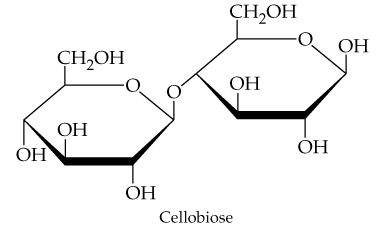
How would you classify the link between the monosaccharides in cellobiose?

Guida verificata passo dopo passo
1
Identify the structure of cellobiose, which is a disaccharide composed of two glucose molecules linked together. Refer to Worked Example 20.5 for the specific structure.
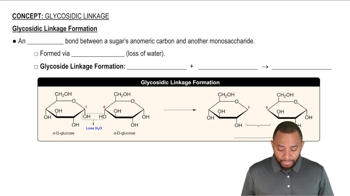
Examine the type of glycosidic bond present between the two glucose units. A glycosidic bond is formed when a hydroxyl group (-OH) from one monosaccharide reacts with the anomeric carbon of another monosaccharide, releasing a molecule of water.
Determine the position of the glycosidic bond. In cellobiose, the bond is typically between the anomeric carbon (C1) of one glucose molecule and the hydroxyl group on the C4 carbon of the second glucose molecule.
Classify the glycosidic bond based on the orientation of the anomeric carbon. If the bond is formed with the hydroxyl group on the anomeric carbon in the beta configuration (pointing up), it is a β(1→4) glycosidic bond.
Conclude that the link between the monosaccharides in cellobiose is a β(1→4) glycosidic bond, as the anomeric carbon of the first glucose is in the beta configuration and is connected to the C4 carbon of the second glucose.

Risposta video verificata per un problema simile:

Questa soluzione video è stata consigliata dai nostri tutor come utile per risolvere questo problema.
Durata del video:
4m

Concetti chiave

Ecco i concetti essenziali che devi comprendere per rispondere correttamente alla domanda.

Glycosidic Bond

A glycosidic bond is a type of covalent bond that connects two monosaccharides through a dehydration reaction, resulting in the formation of a disaccharide. In cellobiose, this bond specifically links the anomeric carbon of one glucose unit to the hydroxyl group of another glucose unit, creating a β(1→4) linkage.
Video consigliato:
Percorso guidato
1:44
Glycosidic Linkage Formation Concept 1

Disaccharides

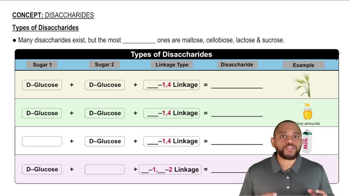
Disaccharides are carbohydrates formed by the combination of two monosaccharides through glycosidic bonds. Cellobiose, composed of two glucose molecules, is an example of a disaccharide that plays a significant role in the structure of cellulose, a major component of plant cell walls.
Video consigliato:
Percorso guidato
3:39
Types of Disaccharides Concept 1

Cellulose

Cellulose is a polysaccharide made up of long chains of β-glucose units linked by β(1→4) glycosidic bonds. It is a key structural component in plant cell walls, providing rigidity and strength. Understanding cellobiose's structure helps in comprehending how cellulose is formed and its importance in biological systems.
Pratica correlata
Domanda del libro di testo

Consider the trisaccharide A, B, C shown in Problem 20.23.

a. Identify the hemiacetal and acetal linkages.

1153
views

Domanda del libro di testo

Draw the structure of the α and β anomers that result from the reaction of methanol and ribose. Are these compounds acetals or hemiacetals?

515
views
Domanda del libro di testo

L-Fucose is one of the naturally occurring L monosaccharides. It is present in the short chains of monosaccharides by which blood groups are classified. Compare the structure of L-fucose shown in the margin with the structures of α- and β-D-galactose and answer the following questions.

d. "Fucose” is a common name. Is 6-deoxy-L-galactose a correct name for fucose? Why or why not?

422
views
Domanda del libro di testo

In the monosaccharide hemiacetal shown below number all the carbon atoms, identify the anomeric carbon atom, and identify it as the α or β anomer.

664
views
Domanda del libro di testo

During the digestion of starch from potatoes, the enzyme α-amylase catalyzes the hydrolysis of starch into maltose. Subsequently, the enzyme maltase catalyzes the hydrolysis of maltose into two glucose units. Write an equation (in words) for the enzymatic conversion of starch to glucose. Classify each of the carbohydrates in the equation as a disaccharide, monosaccharide, or polysaccharide.

1148
views
Domanda del libro di testo

Identify the following as diastereomers, enantiomers, and/or anomers.

(a) β-D-fructose and β-D-fructose

(b) D-galactose and L-galactose

(c) L-allose and D-glucose (both aldohexoses)

687
views