Ch.20 Carbohydrates
McMurry - Fundamentals of General, Organic, and Biological Chemistry 8th Edition
McMurry8th EditionFundamentals of General, Organic, and Biological ChemistryISBN: 9780134015187Non è quello che usi tu?Cambia libro di testo
Capitolo 20, Problema 84

Name a naturally occurring carbohydrate and its source for each type of carbohydrate listed in Problem 20.83.

Guida verificata passo dopo passo
1
Step 1: Understand the types of carbohydrates. Carbohydrates are classified into three main types: monosaccharides, disaccharides, and polysaccharides. Each type has distinct characteristics and examples.
Step 2: Identify a naturally occurring monosaccharide. For example, glucose is a common monosaccharide found in fruits like grapes and is a primary energy source for living organisms.
Step 3: Identify a naturally occurring disaccharide. For instance, sucrose (table sugar) is a disaccharide composed of glucose and fructose. It is commonly found in sugarcane and sugar beets.
Step 4: Identify a naturally occurring polysaccharide. Starch is a polysaccharide that serves as an energy storage molecule in plants. It is found in foods like potatoes, rice, and corn.
Step 5: Summarize the examples and their sources for each carbohydrate type: glucose (monosaccharide) from fruits, sucrose (disaccharide) from sugarcane, and starch (polysaccharide) from plants like potatoes.

Risposta video verificata per un problema simile:

Questa soluzione video è stata consigliata dai nostri tutor come utile per risolvere questo problema.
Durata del video:
3m

Concetti chiave

Ecco i concetti essenziali che devi comprendere per rispondere correttamente alla domanda.

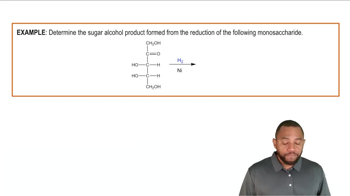
Monosaccharides

Monosaccharides are the simplest form of carbohydrates, consisting of single sugar molecules. Common examples include glucose and fructose, which are naturally found in fruits and honey. They serve as fundamental building blocks for more complex carbohydrates and are crucial for energy production in living organisms.
Video consigliato:
Percorso guidato
0:55
Reduction of Monosaccharides Example 1

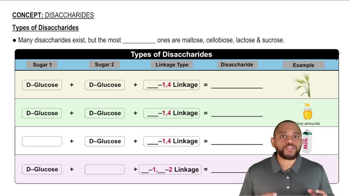
Disaccharides

Disaccharides are carbohydrates formed by the combination of two monosaccharide molecules through a glycosidic bond. Sucrose, commonly known as table sugar, is a well-known disaccharide derived from sugarcane and sugar beets. Disaccharides are important for energy supply and are broken down into monosaccharides during digestion.
Video consigliato:
Percorso guidato
3:39
Types of Disaccharides Concept 1

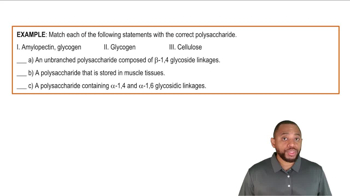
Polysaccharides

Polysaccharides are large, complex carbohydrates composed of long chains of monosaccharide units. Examples include starch, which is found in potatoes and grains, and cellulose, found in plant cell walls. These carbohydrates serve various functions, including energy storage and providing structural support in plants.
Video consigliato:
Percorso guidato
1:24
Polysaccharides Example 1