Ch.21 The Generation of Biochemical Energy
McMurry - Fundamentals of General, Organic, and Biological Chemistry 8th Edition
McMurry8th EditionFundamentals of General, Organic, and Biological ChemistryISBN: 9780134015187Non è quello che usi tu?Cambia libro di testo
Capitolo 21, Problema 41

Arrange the following events in the order in which they occur in a catabolic process: electron transport, digestion, oxidative phosphorylation, citric acid cycle.

Guida verificata passo dopo passo
1
Understand the concept of a catabolic process: Catabolism involves breaking down larger molecules into smaller ones to release energy. This process typically includes digestion, energy extraction, and ATP production.
Identify the first step: Digestion is the initial step where large biomolecules (like carbohydrates, proteins, and fats) are broken down into smaller units (like glucose, amino acids, and fatty acids).
Determine the second step: The smaller molecules enter metabolic pathways, such as glycolysis and the citric acid cycle, where they are further broken down to release electrons and energy in the form of reduced coenzymes (NADH and FADH₂).
Recognize the third step: The electrons carried by NADH and FADH₂ are transferred to the electron transport chain, where a series of redox reactions occur, creating a proton gradient across the mitochondrial membrane.
Identify the final step: Oxidative phosphorylation uses the proton gradient created by the electron transport chain to drive ATP synthesis via ATP synthase, producing the majority of the cell's ATP.

Risposta video verificata per un problema simile:

Questa soluzione video è stata consigliata dai nostri tutor come utile per risolvere questo problema.
Durata del video:
3m

Concetti chiave

Ecco i concetti essenziali che devi comprendere per rispondere correttamente alla domanda.

Catabolism

Catabolism refers to the metabolic pathways that break down molecules into smaller units, releasing energy in the process. This energy is often captured in the form of ATP, which is used by cells for various functions. Understanding catabolism is essential for analyzing how organisms convert food into usable energy.
Video consigliato:
Percorso guidato
2:06
Intro to Amino Acid Catabolism Concept 1

Cellular Respiration

Cellular respiration is the process by which cells convert glucose and oxygen into energy, carbon dioxide, and water. It consists of several stages, including glycolysis, the citric acid cycle, and oxidative phosphorylation. Recognizing the sequence of these stages is crucial for understanding how energy is produced in catabolic processes.
Video consigliato:
Percorso guidato
1:47
Anaerobic Respiration Concept 1

Electron Transport Chain

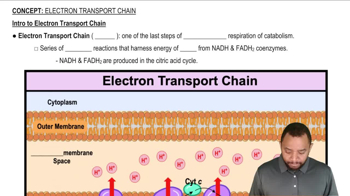
The electron transport chain (ETC) is a series of protein complexes located in the inner mitochondrial membrane that transfer electrons from electron donors to electron acceptors via redox reactions. This process generates a proton gradient that drives ATP synthesis during oxidative phosphorylation, making it a key component of energy production in catabolism.
Video consigliato:
Percorso guidato
3:10
Intro to Electron Transport Chain Concept 1