Ch.21 The Generation of Biochemical Energy
McMurry - Fundamentals of General, Organic, and Biological Chemistry 8th Edition
McMurry8th EditionFundamentals of General, Organic, and Biological ChemistryISBN: 9780134015187Non è quello che usi tu?Cambia libro di testo
Capitolo 21, Problema 42

What key metabolic intermediate is formed from the catabolism of all three major classes of foods: carbohydrates, lipids, and proteins?

Guida verificata passo dopo passo
1
Understand that the question is asking for a common metabolic intermediate that is produced during the breakdown (catabolism) of carbohydrates, lipids, and proteins.
Recall that carbohydrates are broken down into glucose, which undergoes glycolysis to form pyruvate. Pyruvate is then converted into acetyl-CoA during the transition step before entering the citric acid cycle.
Recognize that lipids (fats) are broken down into glycerol and fatty acids. Fatty acids undergo beta-oxidation, a process that produces acetyl-CoA as the main product.
Understand that proteins are broken down into amino acids, which can be deaminated to remove the amino group. The remaining carbon skeletons of amino acids can be converted into various intermediates, including acetyl-CoA, depending on the amino acid.
Conclude that acetyl-CoA is the key metabolic intermediate formed from the catabolism of carbohydrates, lipids, and proteins, as it serves as a central molecule that enters the citric acid cycle for further energy production.

Risposta video verificata per un problema simile:

Questa soluzione video è stata consigliata dai nostri tutor come utile per risolvere questo problema.
Durata del video:
1m

Concetti chiave

Ecco i concetti essenziali che devi comprendere per rispondere correttamente alla domanda.

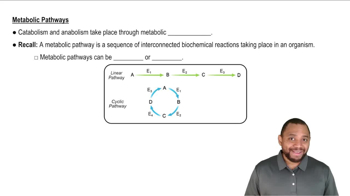
Metabolism

Metabolism refers to the set of life-sustaining chemical reactions in organisms that convert food into energy. It encompasses two main processes: catabolism, which breaks down molecules to release energy, and anabolism, which uses energy to construct components of cells. Understanding metabolism is crucial for grasping how different nutrients are processed in the body.
Video consigliato:
Percorso guidato
0:52
Metabolic Pathways Concept 2

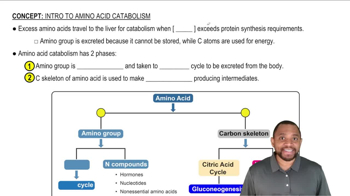
Catabolism

Catabolism is the metabolic pathway that breaks down molecules into smaller units, releasing energy in the process. This process is essential for the conversion of macronutrients—carbohydrates, lipids, and proteins—into usable energy forms. The end products of catabolism are vital for various cellular functions and energy production.
Video consigliato:
Percorso guidato
2:06
Intro to Amino Acid Catabolism Concept 1

Acetyl-CoA

Acetyl-CoA is a key metabolic intermediate that plays a central role in energy production. It is formed from the breakdown of carbohydrates, fats, and proteins, serving as a critical substrate for the citric acid cycle (Krebs cycle). Acetyl-CoA is essential for the synthesis of fatty acids and cholesterol, making it a pivotal molecule in metabolism.
Video consigliato:
Percorso guidato
1:33
Phase B - Succinyl CoA Formation Example 2