After running a mile, you stop and breathe heavily for a short period due to oxygen debt. Why do you need to breathe so heavily? (Hint: Look up “oxygen debt” on the Web. Which metabolic pathway requires oxygen?)
Ch.21 The Generation of Biochemical Energy
McMurry8th EditionFundamentals of General, Organic, and Biological ChemistryISBN: 9780134015187Non è quello che usi tu?Cambia libro di testo
Capitolo 21, Problema 85a
The citric acid cycle contains four 4-carbon dicarboxylic acids.
a. Name them.
Guida verificata passo dopo passo1
Understand the context: The citric acid cycle (also known as the Krebs cycle or TCA cycle) is a series of chemical reactions used by all aerobic organisms to generate energy. It involves several intermediates, including 4-carbon dicarboxylic acids.
Recall the definition of a dicarboxylic acid: A dicarboxylic acid is an organic compound containing two carboxyl (-COOH) groups. In the citric acid cycle, these compounds play a role as intermediates.
Identify the 4-carbon dicarboxylic acids in the citric acid cycle. These are intermediates that contain four carbon atoms and two carboxyl groups. The four compounds are: succinate, fumarate, malate, and oxaloacetate.
Note the sequence in the cycle: Succinate is converted to fumarate, fumarate to malate, and malate to oxaloacetate. These transformations involve oxidation-reduction and hydration reactions.
Summarize the names: The four 4-carbon dicarboxylic acids in the citric acid cycle are succinate, fumarate, malate, and oxaloacetate.

Risposta video verificata per un problema simile:
Questa soluzione video è stata consigliata dai nostri tutor come utile per risolvere questo problema.
Durata del video:
7mConcetti chiave
Ecco i concetti essenziali che devi comprendere per rispondere correttamente alla domanda.
Citric Acid Cycle
The citric acid cycle, also known as the Krebs cycle or TCA cycle, is a key metabolic pathway that occurs in the mitochondria of cells. It plays a crucial role in cellular respiration by oxidizing acetyl-CoA to produce energy in the form of ATP, as well as electron carriers like NADH and FADH2. This cycle is essential for the aerobic metabolism of carbohydrates, fats, and proteins.
Video consigliato:
Percorso guidato
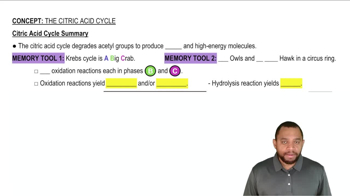
Citric Acid Cycle Summary Concept 12
Dicarboxylic Acids
Dicarboxylic acids are organic compounds that contain two carboxyl functional groups (-COOH). In the context of the citric acid cycle, these acids are intermediates that participate in various reactions, contributing to the cycle's function in energy production. Their structure allows them to undergo decarboxylation and other transformations that are vital for the cycle's progression.
Video consigliato:
Percorso guidato
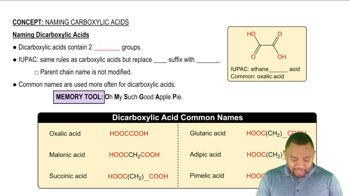
Naming Dicarboxylic Acids Concept 3
4-Carbon Intermediates
In the citric acid cycle, 4-carbon intermediates are crucial for the cycle's continuity and efficiency. The four 4-carbon dicarboxylic acids involved are oxaloacetate, succinate, fumarate, and malate. These compounds facilitate the transfer of carbon atoms and energy through the cycle, ultimately leading to the regeneration of oxaloacetate, which is necessary for the cycle to continue.
Video consigliato:
Percorso guidato
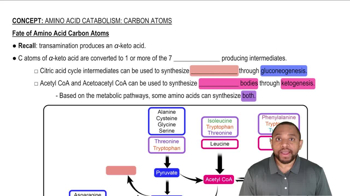
Amino Acid Catabolism: Carbon Atoms Concept 2
Pratica correlata
Domanda del libro di testo
1013
views
Domanda del libro di testo
We talk of burning food in a combustion process, producing CO2 and H2O from food and O2. Explain how O2 is involved in the process although no O2 is directly involved in the citric acid cycle.
1039
views
Domanda del libro di testo
The mitochondrion pumps H+ from the matrix into the intermembrane space. Which region is more acidic, the matrix or the intermembrane space? Why?
Domanda del libro di testo
If you use a flame to burn a pile of glucose completely to give carbon dioxide and water, the overall reaction is identical to the metabolic oxidation of glucose. Explain the differences in the fate of the energy released in each case.
1129
views
Domanda del libro di testo
The citric acid cycle contains four 4-carbon dicarboxylic acids.
b. Arrange them in order from least oxidized to most oxidized.
609
views