Ch.21 The Generation of Biochemical Energy
McMurry - Fundamentals of General, Organic, and Biological Chemistry 8th Edition
McMurry8th EditionFundamentals of General, Organic, and Biological ChemistryISBN: 9780134015187Non è quello che usi tu?Cambia libro di testo
Capitolo 21, Problema 19

The reduced coenzymes NADH and FADH2 are oxidized in the ETS. What is the final electron acceptor of the ETS? What is the function of the H+ ion in ATP synthesis?

Guida verificata passo dopo passo
1
Step 1: Understand the Electron Transport System (ETS). The ETS is a series of protein complexes and electron carriers located in the inner mitochondrial membrane. It is responsible for transferring electrons from reduced coenzymes (NADH and FADH₂) to a final electron acceptor, while simultaneously creating a proton gradient.
Step 2: Identify the final electron acceptor in the ETS. In the ETS, electrons are passed through a series of complexes and carriers, ultimately being transferred to molecular oxygen (O₂), which is the final electron acceptor. Oxygen combines with electrons and protons (H⁺) to form water (H₂O).
Step 3: Explain the role of H⁺ ions in the ETS. As electrons move through the ETS, energy is released and used to pump H⁺ ions from the mitochondrial matrix into the intermembrane space, creating a proton gradient (electrochemical gradient).
Step 4: Describe the function of the H⁺ ion in ATP synthesis. The H⁺ ions flow back into the mitochondrial matrix through ATP synthase, a protein complex that uses the energy from this flow (proton motive force) to synthesize ATP from ADP and inorganic phosphate (Pi). This process is called oxidative phosphorylation.
Step 5: Summarize the importance of the ETS and H⁺ ions. The ETS is essential for cellular respiration, as it generates the majority of ATP in aerobic organisms. The H⁺ ion gradient is the driving force for ATP synthesis, making it a critical component of energy production in cells.

Risposta video verificata per un problema simile:

Questa soluzione video è stata consigliata dai nostri tutor come utile per risolvere questo problema.
Durata del video:
5m

Concetti chiave

Ecco i concetti essenziali che devi comprendere per rispondere correttamente alla domanda.

Electron Transport System (ETS)

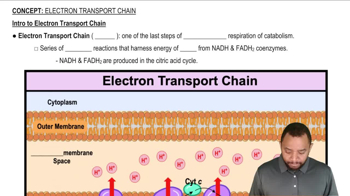
The Electron Transport System (ETS) is a series of protein complexes located in the inner mitochondrial membrane that facilitate the transfer of electrons from reduced coenzymes like NADH and FADH₂ to molecular oxygen. This process generates a proton gradient across the membrane, which is essential for ATP synthesis. The ETS is crucial for cellular respiration, as it is the primary pathway for ATP production in aerobic organisms.
Video consigliato:
Percorso guidato
3:10
Intro to Electron Transport Chain Concept 1

Final Electron Acceptor

In the context of the ETS, the final electron acceptor is molecular oxygen (O₂). As electrons are transferred through the protein complexes of the ETS, they ultimately reduce oxygen to form water. This step is vital for maintaining the flow of electrons through the system and is a key reason why oxygen is essential for aerobic respiration.
Video consigliato:
Percorso guidato
01:23
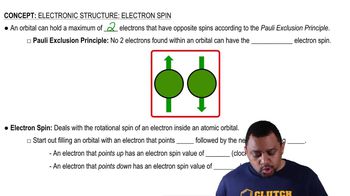
Electronic Structure: Electron Spin Concept 1

Proton Gradient and ATP Synthesis

The proton gradient created by the ETS is critical for ATP synthesis through a process called chemiosmosis. As protons (H⁺ ions) accumulate in the intermembrane space, they create a potential energy difference across the membrane. ATP synthase, an enzyme embedded in the membrane, utilizes this gradient to drive the conversion of ADP and inorganic phosphate into ATP as protons flow back into the mitochondrial matrix.
Video consigliato:
Percorso guidato
2:20
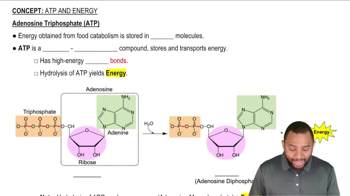
Adenosine Triphosphate (ATP) Concept 2