Lactate can be converted into pyruvate by the enzyme lactate dehydrogenase and the coenzyme NAD+. Write the reaction in the standard biochemical format, using a curved arrow to show the involvement of NAD+.
Ch.22 Carbohydrate Metabolism
McMurry8th EditionFundamentals of General, Organic, and Biological ChemistryISBN: 9780134015187Non è quello che usi tu?Cambia libro di testo
Capitolo 22, Problema 61
Name the anabolic pathway for making glucose.
Guida verificata passo dopo passo1
Understand that an anabolic pathway is a metabolic process that builds larger molecules from smaller ones, requiring energy input.
Recognize that the process of making glucose from non-carbohydrate precursors is called gluconeogenesis.
Recall that gluconeogenesis primarily occurs in the liver and, to a lesser extent, in the kidneys.
Note that gluconeogenesis uses substrates such as pyruvate, lactate, glycerol, and certain amino acids to synthesize glucose.
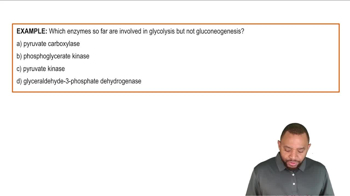
Understand that gluconeogenesis is essentially the reverse of glycolysis, but it bypasses the irreversible steps of glycolysis using specific enzymes like pyruvate carboxylase and phosphoenolpyruvate carboxykinase.

Risposta video verificata per un problema simile:
Questa soluzione video è stata consigliata dai nostri tutor come utile per risolvere questo problema.
Durata del video:
1mConcetti chiave
Ecco i concetti essenziali che devi comprendere per rispondere correttamente alla domanda.
Gluconeogenesis
Gluconeogenesis is the metabolic pathway through which organisms synthesize glucose from non-carbohydrate precursors. This process primarily occurs in the liver and, to a lesser extent, in the kidneys. It is crucial during periods of fasting or intense exercise when glucose levels are low, allowing the body to maintain energy homeostasis.
Video consigliato:
Percorso guidato
Gluconeogenesis Example 2
Anabolic Pathways
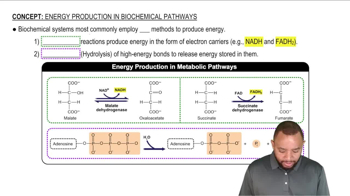
Anabolic pathways are metabolic routes that construct molecules from smaller units, requiring energy input. These pathways are essential for growth, repair, and maintenance of cellular structures. In the context of gluconeogenesis, it represents the synthesis of glucose, contrasting with catabolic pathways that break down molecules to release energy.
Video consigliato:
Percorso guidato
Energy Production In Biochemical Pathways Concept 1
Substrates of Gluconeogenesis
The substrates of gluconeogenesis include lactate, glycerol, and certain amino acids, which serve as building blocks for glucose synthesis. These substrates are converted through a series of enzymatic reactions, ultimately leading to the formation of glucose. Understanding these substrates is vital for grasping how the body generates glucose from various sources during metabolic stress.
Video consigliato:
Percorso guidato
Gluconeogenesis Example 2
Pratica correlata
Domanda del libro di testo
897
views
Domanda del libro di testo
Name the two molecules that serve as starting materials for glucose synthesis.
821
views
Domanda del libro di testo
Explain why the Cori cycle is necessary and when your cells would use this cycle.
686
views
Domanda del libro di testo
Differentiate between blood sugar levels and resulting symptoms in hyperglycemia and hypoglycemia.
751
views
Domanda del libro di testo
How many steps in gluconeogenesis are not the exact reversal of the steps in glycolysis? What kind of conversion of substrate to product does each involve? What is the common theme in each of these reactions?
728
views
Domanda del libro di testo
Why does glycogenolysis use fewer steps than the reverse process, glycogenesis? Which process uses less energy?
1139
views