Ch.23 Lipids
McMurry - Fundamentals of General, Organic, and Biological Chemistry 8th Edition
McMurry8th EditionFundamentals of General, Organic, and Biological ChemistryISBN: 9780134015187Non è quello che usi tu?Cambia libro di testo
Capitolo 23, Problema 48

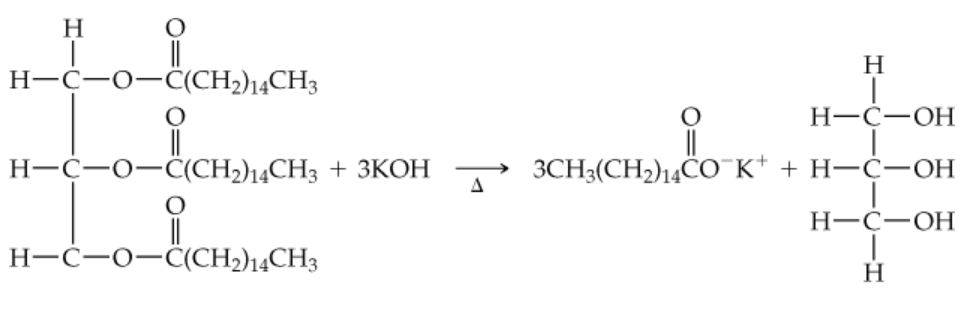
Is the reaction shown here esterification, hydrogenation, hydrolysis, saponification, or substitution?
Chemical reaction diagram illustrating triacylglycerol hydrolysis, showing reactants, products, and hydroxide ions.

Guida verificata passo dopo passo
1
Identify the functional groups and reactants in the reaction. Look for key features such as esters, alcohols, acids, or alkenes in the starting materials and products.
Determine the type of chemical transformation occurring. For example, esterification involves forming an ester from an alcohol and a carboxylic acid, while hydrolysis involves breaking a bond using water.
Check if the reaction involves the addition of hydrogen (hydrogenation), the breaking of an ester bond (saponification or hydrolysis), or the replacement of one group with another (substitution).
Analyze the reaction conditions provided in the image, such as the presence of catalysts, heat, or specific reagents, as these can indicate the type of reaction.
Match the observed transformation and conditions to the correct reaction type: esterification, hydrogenation, hydrolysis, saponification, or substitution.

Risposta video verificata per un problema simile:

Questa soluzione video è stata consigliata dai nostri tutor come utile per risolvere questo problema.
Durata del video:
2m

Concetti chiave

Ecco i concetti essenziali che devi comprendere per rispondere correttamente alla domanda.

Esterification

Esterification is a chemical reaction that forms an ester from an alcohol and a carboxylic acid, typically involving the elimination of water. This process is characterized by the formation of a new carbon-oxygen bond, resulting in the production of an ester compound, which is often used in the production of fragrances and solvents.
Video consigliato:
Percorso guidato
0:46
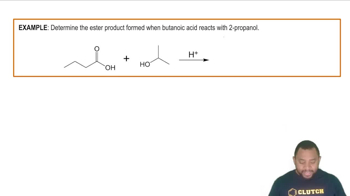
Ester Reactions: Esterification Example 1

Hydrogenation

Hydrogenation is a chemical reaction that involves the addition of hydrogen to unsaturated organic compounds, typically alkenes or alkynes, converting them into saturated hydrocarbons. This process is commonly used in the food industry to convert liquid vegetable oils into solid fats, such as margarine.
Video consigliato:
Percorso guidato
1:22
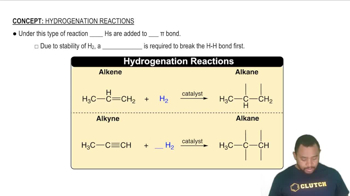
Hydrogenation Reactions Concept 1

Hydrolysis

Hydrolysis is a chemical reaction that involves the breaking down of a compound by reaction with water. In organic chemistry, it often refers to the cleavage of bonds in esters or amides, resulting in the formation of an alcohol and a carboxylic acid or an amine, respectively. This reaction is crucial in biological processes, such as digestion.
Video consigliato:
Percorso guidato
1:12
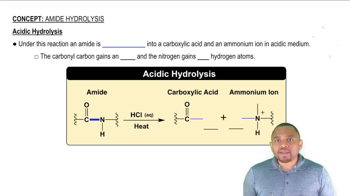
Acidic Hydrolysis Concept 1