Ch.23 Lipids
McMurry - Fundamentals of General, Organic, and Biological Chemistry 8th Edition
McMurry8th EditionFundamentals of General, Organic, and Biological ChemistryISBN: 9780134015187Non è quello che usi tu?Cambia libro di testo
Capitolo 23, Problema 72

Which process requires energy—passive or active transport? Why is energy sometimes required to move solute across the cell membrane?

Guida verificata passo dopo passo
1
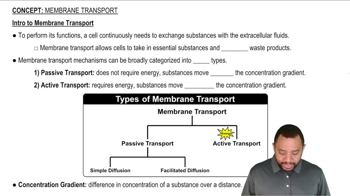
Understand the difference between passive and active transport: Passive transport does not require energy because it relies on the natural movement of molecules from an area of high concentration to an area of low concentration (down the concentration gradient). Active transport, on the other hand, requires energy because it moves molecules against their concentration gradient (from low to high concentration).
Recognize why energy is required in active transport: Moving solutes against their concentration gradient is not a spontaneous process. It requires an input of energy, typically in the form of ATP (adenosine triphosphate), to drive the transport proteins that facilitate this movement.
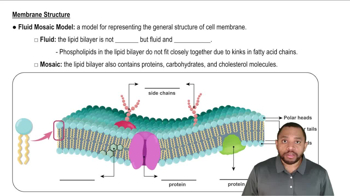
Consider the role of the cell membrane: The cell membrane is selectively permeable, meaning it regulates what enters and exits the cell. For certain solutes that cannot pass freely through the membrane or are being moved against their gradient, energy is needed to assist their transport.
Identify examples of active transport: Processes like the sodium-potassium pump (Na⁺/K⁺ pump) are classic examples of active transport. This pump uses ATP to move sodium ions out of the cell and potassium ions into the cell, maintaining essential concentration gradients.
Summarize the importance of energy in active transport: Energy is required to maintain concentration gradients, import essential nutrients, and remove waste products, all of which are critical for the cell's survival and proper functioning.

Risposta video verificata per un problema simile:

Questa soluzione video è stata consigliata dai nostri tutor come utile per risolvere questo problema.
Durata del video:
1m

Concetti chiave

Ecco i concetti essenziali che devi comprendere per rispondere correttamente alla domanda.

Active Transport

Active transport is a cellular process that requires energy to move molecules against their concentration gradient, from an area of lower concentration to an area of higher concentration. This energy is typically derived from ATP (adenosine triphosphate) and is essential for maintaining cellular homeostasis and nutrient uptake.
Video consigliato:
Percorso guidato
1:21
Membrane Transport Concept 1

Passive Transport

Passive transport is the movement of substances across a cell membrane without the use of energy. This process occurs along the concentration gradient, meaning substances move from areas of higher concentration to areas of lower concentration. Examples include diffusion and osmosis, which allow cells to maintain equilibrium without expending energy.
Video consigliato:
Percorso guidato
1:21
Membrane Transport Concept 1

Cell Membrane Dynamics

The cell membrane is a selectively permeable barrier that regulates the entry and exit of substances. Understanding its dynamics is crucial for grasping why certain processes require energy; for instance, when ions or larger molecules need to be transported against their natural flow, energy is necessary to facilitate this movement and maintain the cell's internal environment.
Video consigliato:
Percorso guidato
2:34
Cell Membranes Concept 2