
Ch.24 Lipid Metabolism
McMurry - Fundamentals of General, Organic, and Biological Chemistry 8th Edition
McMurry8th EditionFundamentals of General, Organic, and Biological ChemistryISBN: 9780134015187Non è quello che usi tu?Cambia libro di testo
Capitolo 24, Problema 70

High blood-cholesterol levels are dangerous because of their correlation with atherosclerosis and consequent heart attacks and strokes. Is it possible to eliminate all cholesterol from the bloodstream by having a diet that includes no cholesterol? Is it desirable to have no cholesterol at all in your body? Explain your answer.

Guida verificata passo dopo passo
1
Understand the role of cholesterol in the body: Cholesterol is a lipid molecule essential for various biological functions, such as forming cell membranes, synthesizing steroid hormones, and producing bile acids for digestion. It is not inherently harmful but becomes problematic at high levels.
Recognize the sources of cholesterol: Cholesterol in the body comes from two main sources—dietary intake and endogenous synthesis. The liver produces cholesterol naturally, even if dietary cholesterol is absent, because it is vital for survival.
Evaluate the possibility of eliminating cholesterol through diet: While dietary cholesterol can be reduced or eliminated by avoiding foods like meat, eggs, and dairy, the body will still produce cholesterol internally to meet its physiological needs. Therefore, it is impossible to completely eliminate cholesterol from the bloodstream through diet alone.
Consider the consequences of having no cholesterol: Having no cholesterol at all would disrupt critical biological processes, such as hormone production and cell membrane integrity, leading to severe health issues. Cholesterol is necessary for normal body function, and its complete absence is undesirable.
Conclude with a balanced perspective: While it is important to manage cholesterol levels to prevent health risks like atherosclerosis, it is equally important to maintain sufficient cholesterol for essential bodily functions. A healthy balance is key.

Risposta video verificata per un problema simile:

Questa soluzione video è stata consigliata dai nostri tutor come utile per risolvere questo problema.
Durata del video:
3m

Concetti chiave

Ecco i concetti essenziali che devi comprendere per rispondere correttamente alla domanda.

Cholesterol Function

Cholesterol is a vital lipid molecule that plays essential roles in the body, including the formation of cell membranes, production of hormones, and synthesis of vitamin D. While high levels of certain types of cholesterol, particularly low-density lipoprotein (LDL), are linked to cardiovascular diseases, cholesterol itself is necessary for various physiological functions.
Video consigliato:
Percorso guidato
02:16
Logarithmic Functions

Dietary Cholesterol vs. Blood Cholesterol

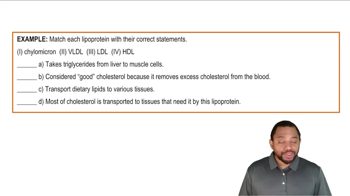
Dietary cholesterol refers to the cholesterol obtained from food sources, while blood cholesterol levels are influenced by both dietary intake and the body's own production. Reducing dietary cholesterol can lower blood cholesterol levels, but it is not possible to eliminate all cholesterol from the bloodstream, as the body synthesizes it endogenously to meet its needs.
Video consigliato:
Percorso guidato
1:27
Lipoproteins for Transport Example 1

Atherosclerosis and Cardiovascular Health

Atherosclerosis is a condition characterized by the buildup of fatty deposits, including cholesterol, in the arterial walls, leading to narrowed arteries and increased risk of heart attacks and strokes. Managing cholesterol levels through diet, exercise, and medication can help reduce the risk of atherosclerosis, but completely eliminating cholesterol is neither feasible nor healthy.
Video consigliato:
Percorso guidato
00:36
What is Chemistry? Example 1