Ch.26 Nucleic Acids and Protein Synthesis
McMurry - Fundamentals of General, Organic, and Biological Chemistry 8th Edition
McMurry8th EditionFundamentals of General, Organic, and Biological ChemistryISBN: 9780134015187Non è quello che usi tu?Cambia libro di testo
Capitolo 26, Problema 41

Draw the complete structure of the RNA dinucleotide U-C. Identify the 5′ and 3′ ends of the dinucleotide.

Guida verificata passo dopo passo
1
Understand that RNA is composed of nucleotides, each consisting of a ribose sugar, a phosphate group, and a nitrogenous base. In this case, the bases are uracil (U) and cytosine (C).
Start by drawing the ribose sugar for the first nucleotide (U). Label the carbon atoms on the ribose as 1′, 2′, 3′, 4′, and 5′. Attach a phosphate group to the 5′ carbon and the uracil base to the 1′ carbon.
Draw the ribose sugar for the second nucleotide (C). Similarly, label the carbon atoms and attach a phosphate group to the 5′ carbon and the cytosine base to the 1′ carbon.
Connect the two nucleotides by forming a phosphodiester bond between the 3′ hydroxyl group (-OH) of the first nucleotide (U) and the phosphate group attached to the 5′ carbon of the second nucleotide (C).
Label the 5′ end of the dinucleotide (where the free phosphate group is attached) and the 3′ end (where the free hydroxyl group is located) to clearly identify the directionality of the RNA strand.

Risposta video verificata per un problema simile:

Questa soluzione video è stata consigliata dai nostri tutor come utile per risolvere questo problema.
Durata del video:
1m

Concetti chiave

Ecco i concetti essenziali che devi comprendere per rispondere correttamente alla domanda.

RNA Structure

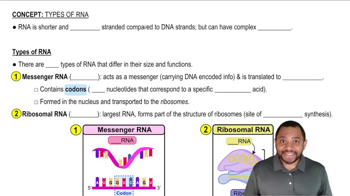
RNA, or ribonucleic acid, is a single-stranded molecule composed of nucleotides, each containing a ribose sugar, a phosphate group, and a nitrogenous base. The sequence of these nucleotides determines the RNA's function, which can include coding for proteins, catalyzing reactions, or regulating gene expression. Understanding the basic structure of RNA is essential for drawing and identifying its components.
Video consigliato:
Percorso guidato
2:43
Types of RNA Concept 1

Nucleotide Composition

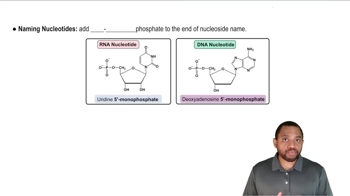
A dinucleotide consists of two nucleotides linked by a phosphodiester bond. In the case of the dinucleotide U-C, the first nucleotide is uridine (U) and the second is cytidine (C). Each nucleotide has a specific orientation, with a 5′ phosphate group and a 3′ hydroxyl group, which are crucial for understanding the directionality of the RNA strand.
Video consigliato:
Percorso guidato
1:21
Naming Nucleosides and Nucleotides Concept 2

5′ and 3′ Ends

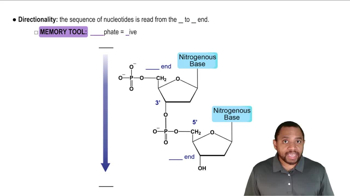
The 5′ and 3′ ends of an RNA molecule refer to the orientation of the sugar-phosphate backbone. The 5′ end has a free phosphate group, while the 3′ end has a free hydroxyl group. This directional notation is important for understanding RNA synthesis and function, as it influences how RNA interacts with other molecules and how it is read during translation.
Video consigliato:
Percorso guidato
1:43
Primary Structure of Nucleic Acids Concept 2