Ch.26 Nucleic Acids and Protein Synthesis
McMurry - Fundamentals of General, Organic, and Biological Chemistry 8th Edition
McMurry8th EditionFundamentals of General, Organic, and Biological ChemistryISBN: 9780134015187Non è quello che usi tu?Cambia libro di testo
Capitolo 26, Problema 45

The DNA from sea urchins contains about 32% A and about 18% G. What percentages of T and C would you expect in sea urchin DNA? Explain.

Guida verificata passo dopo passo
1
Understand the base pairing rules of DNA: Adenine (A) pairs with Thymine (T), and Guanine (G) pairs with Cytosine (C). This means the percentage of A will equal the percentage of T, and the percentage of G will equal the percentage of C.
Add the given percentages of A and G: 32% (A) + 18% (G) = 50%. This represents half of the total DNA base composition, as DNA is composed of four bases (A, T, G, C).
Subtract the sum of A and G from 100% to find the combined percentage of T and C: 100% - 50% = 50%. This represents the total percentage of T and C in the DNA.
Since A pairs with T and G pairs with C, the percentage of T will equal the percentage of A (32%), and the percentage of C will equal the percentage of G (18%).
Conclude that the expected percentages of T and C in sea urchin DNA are 32% and 18%, respectively, based on the complementary base pairing rules.

Risposta video verificata per un problema simile:

Questa soluzione video è stata consigliata dai nostri tutor come utile per risolvere questo problema.
Durata del video:
2m

Concetti chiave

Ecco i concetti essenziali che devi comprendere per rispondere correttamente alla domanda.

Chargaff's Rules

Chargaff's Rules state that in a double-stranded DNA molecule, the amount of adenine (A) is equal to thymine (T), and the amount of guanine (G) is equal to cytosine (C). This means that if you know the percentage of one base, you can determine the percentage of its complementary base. For example, if A is 32%, then T must also be 32%.
Video consigliato:
Percorso guidato
00:28
Solubility Rules

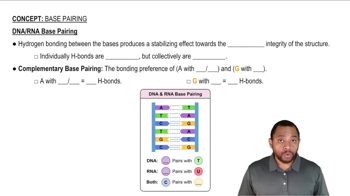
Base Pairing in DNA

Base pairing in DNA refers to the specific pairing of nitrogenous bases: adenine pairs with thymine, and guanine pairs with cytosine. This complementary base pairing is crucial for the structure of DNA and ensures accurate replication and transcription. Understanding this concept is essential for calculating the percentages of the bases in the DNA sequence.
Video consigliato:
Percorso guidato
2:56
Base Pairing Concept 1

Percentage Composition of DNA Bases

The percentage composition of DNA bases is the relative amount of each of the four nucleotides (A, T, G, C) in a DNA molecule. In the case of sea urchin DNA, knowing the percentages of A and G allows us to calculate the percentages of T and C using Chargaff's Rules. This concept is fundamental for understanding the overall structure and function of DNA.
Video consigliato:
Percorso guidato
3:27
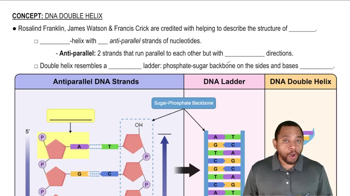
DNA Double Helix Concept 1