Ch.26 Nucleic Acids and Protein Synthesis
McMurry - Fundamentals of General, Organic, and Biological Chemistry 8th Edition
McMurry8th EditionFundamentals of General, Organic, and Biological ChemistryISBN: 9780134015187Non è quello che usi tu?Cambia libro di testo
Capitolo 26, Problema 51

Rank the following in order of size: tRNA, DNA, mRNA.

Guida verificata passo dopo passo
1
Understand the biological molecules involved: tRNA (transfer RNA), DNA (deoxyribonucleic acid), and mRNA (messenger RNA). These molecules differ in size and function within the cell.
Recall that DNA is typically the largest molecule among the three. It contains the genetic blueprint for an organism and is composed of long chains of nucleotides organized into chromosomes.
Consider mRNA, which is synthesized from DNA during transcription. mRNA is smaller than DNA because it represents only a specific segment of the genetic code needed for protein synthesis.
Evaluate tRNA, which is the smallest of the three. tRNA molecules are compact and specialized for transferring amino acids during translation, making them significantly smaller than both DNA and mRNA.
Rank the molecules in order of size based on the above information: DNA (largest), mRNA (intermediate), tRNA (smallest).

Risposta video verificata per un problema simile:

Questa soluzione video è stata consigliata dai nostri tutor come utile per risolvere questo problema.
Durata del video:
2m

Concetti chiave

Ecco i concetti essenziali che devi comprendere per rispondere correttamente alla domanda.

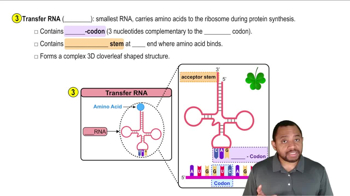
tRNA (Transfer RNA)

tRNA is a small RNA molecule, typically about 76 to 90 nucleotides long, that plays a crucial role in protein synthesis. It carries amino acids to the ribosome, where proteins are assembled, and has an anticodon that pairs with the corresponding codon on mRNA. Its relatively small size compared to other RNA and DNA types makes it the shortest among the three.
Video consigliato:
Percorso guidato
2:23
Types of RNA Concept 2

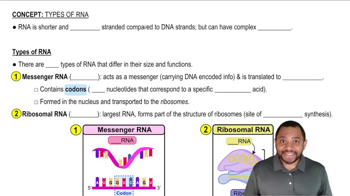
mRNA (Messenger RNA)

mRNA is a single-stranded RNA molecule that conveys genetic information from DNA to the ribosome, where proteins are synthesized. It is generally longer than tRNA, ranging from hundreds to thousands of nucleotides, depending on the gene being expressed. mRNA serves as a template for translation, making it larger than tRNA but smaller than DNA.
Video consigliato:
Percorso guidato
2:43
Types of RNA Concept 1

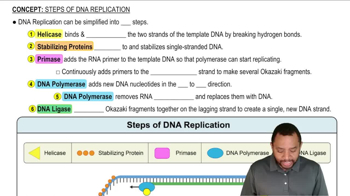
DNA (Deoxyribonucleic Acid)

DNA is a double-stranded molecule that contains the genetic blueprint for all living organisms. It is composed of long chains of nucleotides, with a typical length of millions of base pairs, making it the largest of the three types of nucleic acids. DNA's structure allows it to store and transmit genetic information, which is essential for growth, development, and reproduction.
Video consigliato:
Percorso guidato
5:08
Steps of DNA Replication Concept 1