Ch.1 Chemistry in Our Lives
Timberlake - Chemistry: An Introduction to General, Organic, and Biological Chemistry 13th Edition
Timberlake13th EditionChemistry: An Introduction to General, Organic, and Biological ChemistryISBN: 9780134421353Non è quello che usi tu?Cambia libro di testo
Capitolo 1, Problema 55d

Use the following graph for problems 1.55 and 1.56:
<IMAGE>
d. Does the solubility of carbon dioxide increase or decrease with an increase in temperature?

Guida verificata passo dopo passo
1
Step 1: Analyze the graph provided. The graph shows the solubility of O₂ (g) in H₂O (l) as a function of temperature. The solubility decreases as the temperature increases, indicated by the downward slope of the curve.
Step 2: Understand the relationship between temperature and gas solubility. For gases like carbon dioxide (CO₂) and oxygen (O₂), solubility in liquids typically decreases with an increase in temperature. This is because higher temperatures provide more kinetic energy to gas molecules, making them less likely to remain dissolved in the liquid.
Step 3: Apply this concept to carbon dioxide. Although the graph specifically shows oxygen, the behavior of carbon dioxide is similar because both are gases. As temperature increases, the solubility of carbon dioxide in water also decreases.
Step 4: Relate this observation to real-world phenomena. For example, warmer water bodies tend to hold less dissolved carbon dioxide and oxygen, which can impact aquatic ecosystems.
Step 5: Conclude that the solubility of carbon dioxide decreases with an increase in temperature, based on the general behavior of gases and the trend shown in the graph for oxygen.

Risposta video verificata per un problema simile:

Questa soluzione video è stata consigliata dai nostri tutor come utile per risolvere questo problema.
Durata del video:
1m

Concetti chiave

Ecco i concetti essenziali che devi comprendere per rispondere correttamente alla domanda.

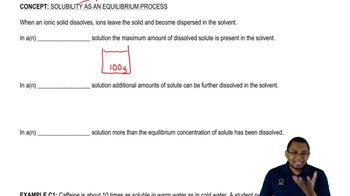
Solubility of Gases

Solubility refers to the ability of a substance (solute) to dissolve in a solvent. For gases, solubility is influenced by temperature, pressure, and the nature of the gas and solvent. Generally, the solubility of gases in liquids decreases as temperature increases, which is critical for understanding gas behavior in aquatic environments.
Video consigliato:
Percorso guidato
00:28
Solubility Rules

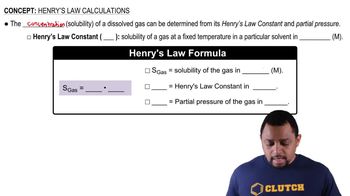
Henry's Law

Henry's Law states that the amount of gas that dissolves in a liquid at a given temperature is proportional to the partial pressure of that gas above the liquid. This principle helps explain how changes in temperature and pressure affect gas solubility, particularly in scenarios involving carbon dioxide and oxygen in water.
Video consigliato:
Percorso guidato
01:41
Henry's Law Calculations Concept 1

Temperature Effects on Solubility

Temperature significantly impacts the solubility of substances. For gases, increasing temperature typically leads to decreased solubility due to increased kinetic energy, which allows gas molecules to escape from the liquid phase. This concept is essential for predicting how temperature changes can affect aquatic ecosystems and gas exchange processes.
Video consigliato:
Percorso guidato
04:38
Solubility: Temperature Effect Concept 1