Ch.10 Acids and Bases and Equilibrium
Timberlake - Chemistry: An Introduction to General, Organic, and Biological Chemistry 13th Edition
Timberlake13th EditionChemistry: An Introduction to General, Organic, and Biological ChemistryISBN: 9780134421353Non è quello che usi tu?Cambia libro di testo
Capitolo 10, Problema 107b

Determine each of the following for a 0.050 M KOH solution:
b. pH

Guida verificata passo dopo passo
1
Step 1: Recognize that KOH is a strong base, meaning it completely dissociates in water. The concentration of OH⁻ ions in the solution will be equal to the concentration of KOH, which is 0.050 M.
Step 2: Use the relationship between pOH and the hydroxide ion concentration [OH⁻]. The formula is: pOH=-log(OH-). Substitute [OH⁻] = 0.050 M into the formula.
Step 3: Calculate the pOH value using the logarithmic expression. This step involves taking the negative logarithm of 0.050.
Step 4: Use the relationship between pH and pOH to find the pH. The formula is: pH=14-pOH. Substitute the calculated pOH value into this formula.
Step 5: Simplify the expression to determine the pH of the solution. This will give you the final pH value for the 0.050 M KOH solution.

Risposta video verificata per un problema simile:

Questa soluzione video è stata consigliata dai nostri tutor come utile per risolvere questo problema.
Durata del video:
1m

Concetti chiave

Ecco i concetti essenziali che devi comprendere per rispondere correttamente alla domanda.

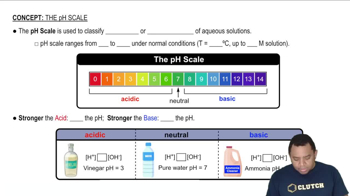
pH Scale

The pH scale measures the acidity or basicity of a solution, ranging from 0 to 14. A pH of 7 is neutral, below 7 indicates acidity, and above 7 indicates basicity. The scale is logarithmic, meaning each whole number change represents a tenfold change in hydrogen ion concentration.
Video consigliato:

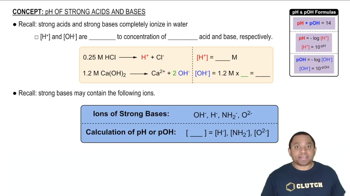
Strong Bases

Strong bases, like potassium hydroxide (KOH), completely dissociate in water to produce hydroxide ions (OH-). This complete dissociation means that the concentration of hydroxide ions in a solution directly corresponds to the concentration of the base, allowing for straightforward calculations of pH.
Video consigliato:
Percorso guidato
02:39
Strong Acids and Bases

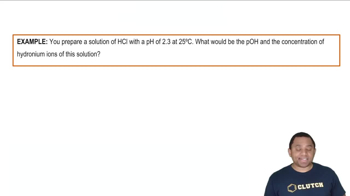
Calculating pH from pOH

To find the pH of a solution, one can first calculate the pOH, which is derived from the concentration of hydroxide ions. The relationship between pH and pOH is given by the equation pH + pOH = 14. Thus, knowing the pOH allows for easy conversion to pH, essential for determining the acidity or basicity of the solution.
Video consigliato:
Percorso guidato
01:46
pH and pOH Example