Ch.10 Acids and Bases and Equilibrium
Timberlake - Chemistry: An Introduction to General, Organic, and Biological Chemistry 13th Edition
Timberlake13th EditionChemistry: An Introduction to General, Organic, and Biological ChemistryISBN: 9780134421353Non è quello che usi tu?Cambia libro di testo
Capitolo 10, Problema 77

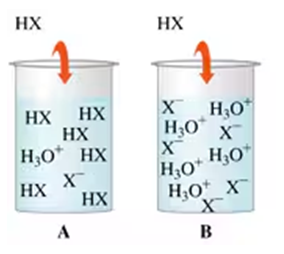
Determine if each of the following diagrams represents a strong acid or a weak acid. The acid has the formula HX.

Guida verificata passo dopo passo
1
Step 1: Analyze the diagrams provided. The left diagram shows a solution where almost all molecules of HX have dissociated into H₃O⁺ and A⁻ ions, while the right diagram shows a solution where only a few molecules of HX have dissociated, leaving most of the HX molecules intact.
Step 2: Recall the definition of a strong acid. A strong acid completely dissociates in water, meaning that nearly all acid molecules (HX) break apart into H₃O⁺ and A⁻ ions.
Step 3: Recall the definition of a weak acid. A weak acid only partially dissociates in water, meaning that most of the acid molecules (HX) remain intact, with only a small fraction breaking apart into H₃O⁺ and A⁻ ions.
Step 4: Compare the diagrams to the definitions. The left diagram represents a strong acid because it shows complete dissociation of HX into H₃O⁺ and A⁻ ions. The right diagram represents a weak acid because it shows partial dissociation, with many HX molecules remaining intact.
Step 5: Conclude that the left diagram corresponds to a strong acid, while the right diagram corresponds to a weak acid, based on the degree of dissociation observed in each solution.

Risposta video verificata per un problema simile:

Questa soluzione video è stata consigliata dai nostri tutor come utile per risolvere questo problema.
Durata del video:
1m

Concetti chiave

Ecco i concetti essenziali che devi comprendere per rispondere correttamente alla domanda.

Strong Acids vs. Weak Acids

Strong acids completely dissociate in water, meaning that all of the acid molecules break apart into ions. This results in a high concentration of hydronium ions (H3O+) in solution. In contrast, weak acids only partially dissociate, leading to a lower concentration of H3O+ and a mixture of undissociated acid molecules and ions.
Video consigliato:
Percorso guidato
01:02
Strong Acid Strong Base Titrations (Simplified) Concept 1

Dissociation Equilibrium

The dissociation of acids in water can be described by an equilibrium reaction. For weak acids, the equilibrium lies to the left, indicating that a significant amount of the acid remains undissociated. In strong acids, the equilibrium lies far to the right, favoring the formation of ions, which is why they are considered strong.
Video consigliato:
Percorso guidato
03:43
The Equilibrium Constant Example 1

Acid Strength and pH

The strength of an acid is often measured by its pH level, which indicates the concentration of H3O+ ions in solution. Strong acids typically have a low pH (below 3), while weak acids have a higher pH (above 3). Understanding the relationship between acid strength and pH is crucial for determining the nature of the acid represented in the diagrams.
Video consigliato:
Percorso guidato
00:50
Acid and Base Strength Concept 3