Ch.11 Introduction to Organic Chemistry: Hydrocarbons
Timberlake - Chemistry: An Introduction to General, Organic, and Biological Chemistry 13th Edition
Timberlake13th EditionChemistry: An Introduction to General, Organic, and Biological ChemistryISBN: 9780134421353Non è quello che usi tu?Cambia libro di testo
Capitolo 11, Problema 46b

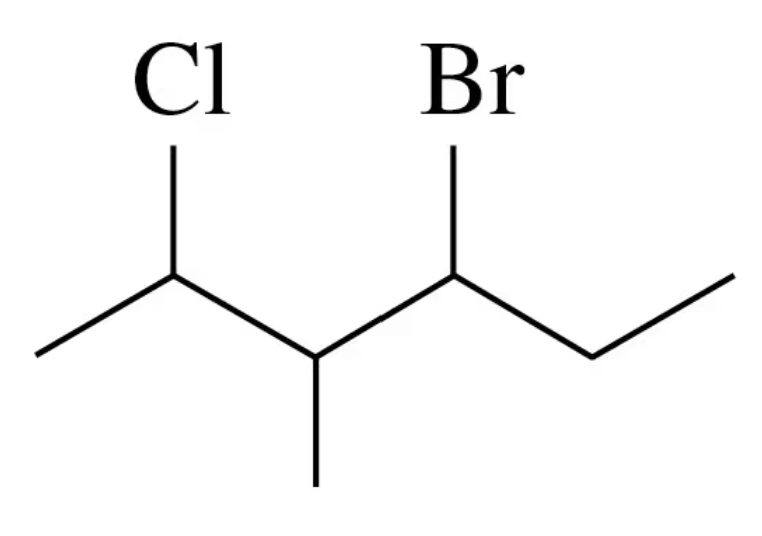
Convert each of the following line-angle formulas to a condensed structural formula and give its IUPAC name:
b. Line-angle formula showing chlorine and bromine substituents on a carbon chain for structural formula conversion.

Guida verificata passo dopo passo
1
Examine the line-angle formula provided in the image. Each vertex or endpoint of a line represents a carbon atom, and the lines represent bonds between them. Hydrogen atoms are implied to satisfy the valency of carbon (4 bonds total).
Identify the longest continuous chain of carbon atoms in the structure. This will serve as the parent chain for naming the compound according to IUPAC rules.
Determine the substituents (groups attached to the parent chain) and their positions on the chain. Number the carbon atoms in the parent chain starting from the end closest to the first substituent to assign the lowest possible numbers.
Write the condensed structural formula by explicitly showing the arrangement of atoms in the molecule. For example, group hydrogens with their attached carbons (e.g., CH3, CH2) and list substituents in their appropriate positions.
Combine the information to name the compound using IUPAC nomenclature. Start with the substituents (in alphabetical order), followed by the parent chain name, and include position numbers for substituents as needed.

Risposta video verificata per un problema simile:

Questa soluzione video è stata consigliata dai nostri tutor come utile per risolvere questo problema.

Concetti chiave

Ecco i concetti essenziali che devi comprendere per rispondere correttamente alla domanda.

Line-Angle Formula

A line-angle formula, also known as a skeletal formula, is a simplified representation of a molecular structure where vertices represent carbon atoms and lines represent bonds. This format allows chemists to visualize the connectivity of atoms in organic compounds without explicitly showing all hydrogen atoms, making it easier to interpret complex structures.
Video consigliato:
Percorso guidato
01:24
Bond Angles (Simplified) Concept 1

Condensed Structural Formula

A condensed structural formula provides a more detailed representation of a molecule than a line-angle formula, showing how atoms are grouped together. It typically lists atoms in a linear format, indicating the connectivity and arrangement of atoms, which helps in understanding the molecular structure and functional groups present in the compound.
Video consigliato:
Percorso guidato
1:53
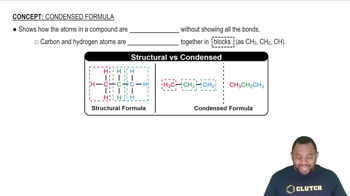
Condensed Formula Concept 1

IUPAC Naming

IUPAC naming refers to the systematic method established by the International Union of Pure and Applied Chemistry for naming chemical compounds. This nomenclature provides a unique name for each compound based on its structure, ensuring clarity and consistency in communication among chemists. The name reflects the compound's functional groups, carbon chain length, and branching.
Video consigliato:
Percorso guidato
3:18
IUPAC Naming Concept 3