Ch.11 Introduction to Organic Chemistry: Hydrocarbons
Timberlake - Chemistry: An Introduction to General, Organic, and Biological Chemistry 13th Edition
Timberlake13th EditionChemistry: An Introduction to General, Organic, and Biological ChemistryISBN: 9780134421353Non è quello che usi tu?Cambia libro di testo
Capitolo 11, Problema 27d

Draw the condensed structural formula, or line-angle formula, if cyclic, for each of the following:
d. 3-chloro-1-butyne

Guida verificata passo dopo passo
1
Step 1: Understand the name of the compound. '3-chloro-1-butyne' indicates a four-carbon chain (butyne) with a triple bond starting at carbon 1 and a chlorine atom attached to carbon 3.
Step 2: Begin by drawing the main chain. Represent the four-carbon chain with a triple bond between carbon 1 and carbon 2. Use the condensed structural formula format: CH≡C-CH₂-CH₃.
Step 3: Add the chlorine substituent. Attach a chlorine atom (Cl) to carbon 3 in the chain. This modifies the structure to CH≡C-CH(Cl)-CH₃.
Step 4: Verify the structure. Ensure the triple bond is correctly placed between carbon 1 and carbon 2, and the chlorine atom is attached to carbon 3. Confirm that all carbons have the correct number of bonds (hydrogens or substituents).
Step 5: If needed, convert the condensed structural formula into a line-angle formula. Represent the triple bond as three parallel lines, and show the chlorine atom as a branch off the third carbon in the chain.

Risposta video verificata per un problema simile:

Questa soluzione video è stata consigliata dai nostri tutor come utile per risolvere questo problema.

Concetti chiave

Ecco i concetti essenziali che devi comprendere per rispondere correttamente alla domanda.

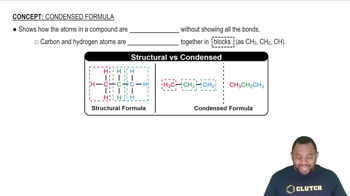
Condensed Structural Formula

A condensed structural formula is a way of representing a chemical compound that shows the arrangement of atoms and the connectivity between them without depicting all the bonds explicitly. It typically groups atoms together to indicate how they are connected, making it easier to visualize the structure of the molecule. For example, in 3-chloro-1-butyne, the condensed formula would highlight the presence of the chlorine atom and the triple bond in the butyne structure.
Video consigliato:
Percorso guidato
1:53
Condensed Formula Concept 1

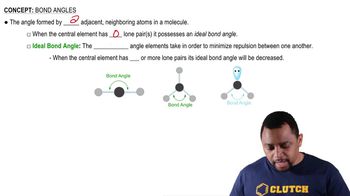
Line-Angle Formula

The line-angle formula, also known as the skeletal formula, is a simplified way of drawing organic molecules where vertices represent carbon atoms and lines represent bonds. This method omits hydrogen atoms attached to carbons, making it easier to visualize complex structures, especially in cyclic compounds. For cyclic structures, the line-angle formula effectively conveys the arrangement of atoms and bonds without clutter.
Video consigliato:
Percorso guidato
01:24
Bond Angles (Simplified) Concept 1

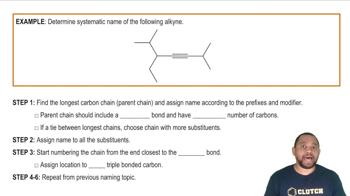
Alkynes

Alkynes are a class of hydrocarbons characterized by at least one carbon-carbon triple bond. They follow the general formula CnH2n-2, where 'n' is the number of carbon atoms. In the case of 3-chloro-1-butyne, the presence of the triple bond between the first and second carbon atoms defines its reactivity and properties, making it important to accurately represent in structural formulas.
Video consigliato:
Percorso guidato
4:11
Naming Alkynes Example 1