Ch.11 Introduction to Organic Chemistry: Hydrocarbons
Timberlake - Chemistry: An Introduction to General, Organic, and Biological Chemistry 13th Edition
Timberlake13th EditionChemistry: An Introduction to General, Organic, and Biological ChemistryISBN: 9780134421353Non è quello che usi tu?Cambia libro di testo
Capitolo 11, Problema 70

Draw the condensed structural formulas for all the possible haloalkane isomers that have four carbon atoms and a bromine.

Guida verificata passo dopo passo
1
Step 1: Understand the problem. A haloalkane is an alkane where one or more hydrogen atoms are replaced by a halogen atom. In this case, we are tasked with finding all possible isomers of haloalkanes with four carbon atoms and one bromine atom.
Step 2: Begin by identifying the parent chain. The parent chain must contain four carbon atoms, which corresponds to butane (C₄H₁₀). The bromine atom will replace one hydrogen atom in the structure.
Step 3: Consider the possible positions for the bromine atom. For a straight-chain butane, bromine can be attached to either the first carbon (1-bromobutane) or the second carbon (2-bromobutane). These are positional isomers.
Step 4: Explore branching possibilities. A branched-chain alkane with four carbons is isobutane (2-methylpropane). Bromine can be attached to either the first carbon (1-bromo-2-methylpropane) or the second carbon (2-bromo-2-methylpropane). These are structural isomers.
Step 5: Verify that all possible isomers are accounted for. Ensure that no additional unique arrangements of the bromine atom exist and confirm that the condensed structural formulas for each isomer are correct. For example, 1-bromobutane can be written as CH₃CH₂CH₂CH₂Br, and 2-bromobutane as CH₃CH₂CHBrCH₃.

Risposta video verificata per un problema simile:

Questa soluzione video è stata consigliata dai nostri tutor come utile per risolvere questo problema.

Concetti chiave

Ecco i concetti essenziali che devi comprendere per rispondere correttamente alla domanda.

Haloalkanes

Haloalkanes, also known as alkyl halides, are organic compounds derived from alkanes by replacing one or more hydrogen atoms with halogen atoms (such as bromine, chlorine, or iodine). They are characterized by the presence of a carbon-halogen bond, which influences their reactivity and physical properties. Understanding haloalkanes is essential for identifying their structural isomers.

Structural Isomers

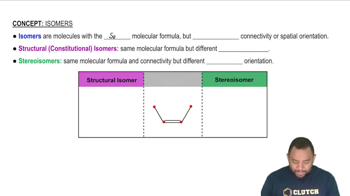
Structural isomers are compounds that have the same molecular formula but differ in the arrangement of atoms. In the case of haloalkanes with four carbon atoms and a bromine atom, various structural isomers can arise from different branching patterns and the position of the bromine atom. Recognizing these isomers is crucial for drawing their condensed structural formulas.
Video consigliato:
Percorso guidato
2:16
Isomers Concept 1

Condensed Structural Formulas

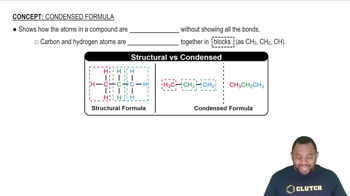
Condensed structural formulas provide a simplified representation of a molecule's structure, showing how atoms are connected without depicting all the bonds explicitly. For haloalkanes, these formulas indicate the arrangement of carbon and halogen atoms, allowing for a clear understanding of the compound's structure. Mastery of this notation is important for accurately representing the various isomers.
Video consigliato:
Percorso guidato
1:53
Condensed Formula Concept 1